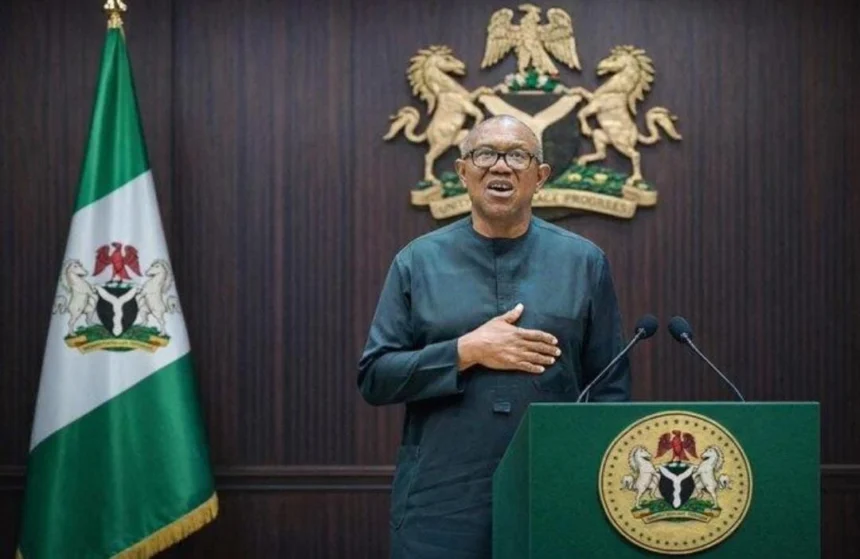
Peter Obi, the presidential candidate of the Nigeria Democratic Congress (NDC), has questioned President Bola Tinubu’s ability to effectively lead Nigeria, arguing that the country needs a leader with the physical presence and energy to tackle its economic and security challenges.
Obi, a former governor of Anambra State, called on Tinubu to leave office after his current term in 2027, insisting that the President’s administration had failed to deliver meaningful improvements in the lives of Nigerians.
“Above all, President Tinubu does not have the energy and resolve required to lead Nigeria today, and he must go home,” Obi said.
Follow PenTalk News
Get breaking news, important updates and the latest stories directly on your phone.
He added that the country needed a president who would be consistently available to attend to national affairs and address the challenges confronting citizens.
Obi made the remarks in Abuja during the inauguration of the NDC National Campaign Council, where he criticised the All Progressives Congress (APC)-led administration over rising poverty, unemployment, corruption and insecurity.
His comments have added to the ongoing political debate surrounding Tinubu’s health and his level of participation in campaign activities ahead of the 2027 presidential election.
Tinubu Explains Decision to Skip Some Campaign Rallies
The controversy followed Tinubu’s announcement that he would not personally attend every APC campaign rally during the 2027 election season.
Speaking at the inauguration of the APC Presidential Campaign Council on October 14, the President said he had accepted advice to limit his participation in campaign activities to avoid compromising his responsibilities as head of government.
Tinubu explained that governing the country required considerable attention, particularly as his administration continued to manage national obligations and economic challenges.
“You will excuse me from going everywhere with you. We have bills to pay. The American creditors cannot wait,” the President said.
He, however, maintained that he would continue to communicate directly with Nigerians during the campaign period.
The APC’s proposed campaign schedule subsequently indicated that Tinubu would attend rallies in 12 states, while party officials would oversee campaign activities in the remaining states.
The arrangement attracted criticism from opposition politicians and commentators, some of whom questioned the President’s decision not to visit every state personally while seeking another term.
The ruling party has defended the plan, describing it as a practical approach to balancing governance with electioneering.
Obafemi George, a member of the APC Presidential Campaign Council’s media and strategic communications committee, argued that no law requires a presidential candidate to physically campaign in all 36 states.
The debate over Tinubu’s health also intensified following his return to Nigeria on September 29 after an extended stay in Europe.
Responding to questions about his physical condition, the President dismissed concerns, telling journalists: “Ready to kick, ready to walk. There’s nothing wrong.”
Obi Challenges Tinubu Over Borrowing and Governance
During his address at the NDC event, Obi also questioned the substance of Tinubu’s re-election campaign, arguing that the President should explain how public funds and borrowed money had been spent before seeking another mandate from Nigerians.
According to Obi, the administration should account for its performance under the 2023, 2024 and 2025 budgets rather than focus on blaming the opposition for the country’s economic difficulties.
He criticised Tinubu for launching his re-election campaign without adequately explaining the results achieved through government expenditure and borrowing.
The President launched his re-election campaign in Kaduna on October 24, where he defended his administration’s economic reforms and blamed opposition politicians for contributing to the country’s poverty and hunger.
Tinubu’s removal of the petrol subsidy and foreign-exchange reforms have affected government finances and the wider economy. However, the policies have also contributed to significant increases in living costs, leaving many households struggling with the prices of food, transportation and other essential goods.
The economic situation remains a major issue in the political contest ahead of the 2027 election.
Obi said his proposed administration would adopt a different approach, focusing on practical measures to resolve national problems rather than assigning blame.
“The purpose of governance is to solve problems, not to blame people. I will not blame anybody. We will create that new Nigeria that is possible,” he said.
He also identified corruption as a major barrier to Nigeria’s development, promising to intensify efforts to tackle the problem if elected president.
“We need a revolution that will turn this country around, and we are committed to that. The APC-led government under President Tinubu has failed Nigeria,” Obi stated.
Obi Raises Concerns Over Poverty, Hunger and Insecurity
The NDC presidential candidate further criticised Nigeria’s performance on international indices measuring terrorism, hunger and poverty.
Obi claimed that the country’s position on these indicators had deteriorated since Tinubu assumed office in May 2023.
“There is no single indicator under Tinubu that has improved. When he came into office, our record on terrorism was better. Today, we are number four,” he said.
He also referred to Nigeria’s position on hunger and poverty rankings, arguing that the figures reflected the challenges facing the country under the current administration.
“When he came in, we were ranked 109th on the hunger list. Today, we are the 117th. When he came in, our poverty ranking was below 140. Today, we are above 140,” Obi added.
The figures represent Obi’s claims at the campaign council inauguration and would require verification against the specific international indices and reporting periods to establish the comparisons.
The NDC event was attended by Rabiu Musa Kwankwaso, the party’s vice-presidential candidate; Seriake Dickson, its national leader; members of the National Working Committee; and other party officials.
Obi’s remarks signal an intensifying opposition challenge to Tinubu as political parties prepare for the 2027 presidential election, with economic hardship, insecurity, accountability and leadership capacity expected to remain central issues in the campaign.