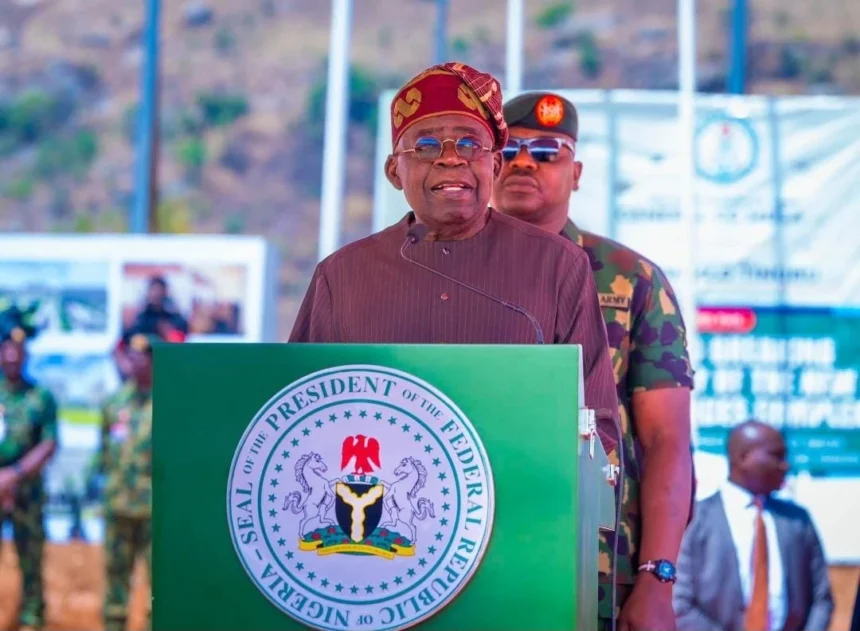
President Bola Tinubu has blamed opposition parties for the hunger and poverty confronting Nigerians, maintaining that his administration is working to address the challenges. He made the remarks on Saturday during the All Progressives Congress (APC) presidential campaign flag-off in Kaduna State ahead of the 2027 general elections.
Speaking at Ranchers Bees Stadium, also known as Kaduna Township Stadium, Tinubu accused opposition politicians of contributing to the country’s economic difficulties while criticising his government’s policies.
“I have heard the opposition talking about hunger and poverty. Who caused them? They did! They caused hunger and poverty. We are trying to eliminate them,” the president said.
Follow PenTalk News
Get breaking news, important updates and the latest stories directly on your phone.
Tinubu also urged his supporters not to be misled by opposition criticism, particularly regarding his decision to remove the petrol subsidy.
He maintained that the country would not return to the previous subsidy arrangement, which his administration has repeatedly linked to corruption, fuel smuggling and the falsification of invoices.
“Be careful; watch them. Don’t let them lie to you. What is past is in the past.
“Fuel subsidy is in our past: no more corruption, no more falsification of invoices, no more lies, no more smuggling of fuel,” he told the crowd.
The president’s comments come amid continuing public concerns over rising food prices, inflation and the declining purchasing power of households. These issues are expected to remain central to political campaigns and debates ahead of the 2027 elections.
Atiku Faults Tinubu’s Explanation for Economic Hardship
Former Vice President Atiku Abubakar, the presidential candidate of the African Democratic Congress (ADC), criticised Tinubu’s remarks, accusing the president of avoiding responsibility for the country’s economic challenges.
In a statement issued by Phrank Shaibu, Director of Strategic Communication for the ADC Presidential Campaign Council, Atiku described the president’s position as “a delusional, shameless attempt to dodge responsibility for the misery his own government has inflicted on Nigerians.”
He argued that the administration could not introduce policies that increased economic pressure on citizens and subsequently blame political opponents for highlighting their consequences.
“Mr President, blaming the opposition for hunger is either delusion or a staggering case of political amnesia. The APC governed Nigeria for eight years before you took office. You have added another three and a half years. Nigerians know who has been in power, and hardship did not begin when the opposition started talking about it. Stop insulting their intelligence and answer for your record,” Atiku said.
The former vice president maintained that Nigerians were experiencing genuine economic difficulties that could not be dismissed through political arguments.
He also questioned the administration’s handling of the foreign exchange market, public spending, energy security and national security.
Atiku specifically challenged the government to explain the depreciation of the naira, poverty projections attributed to the World Bank, expenditure associated with the Nigerian National Petroleum Company Limited (NNPC) and reported gaps in Nigeria’s external accounts.
He further criticised the government’s response to insecurity, including killings, kidnappings and the displacement of residents in affected communities.
According to him, the 2027 presidential election would provide voters with an opportunity to assess Tinubu’s performance based on their experiences under his administration.
“The people will judge your government by the lives they are living, not by the excuses you offer at campaign rallies,” he said.
Atiku also faulted the president’s decision to commission the Abuja-Kaduna Expressway while the project was allegedly unfinished, arguing that a public speech or ceremony could not substitute for the completion of infrastructure projects.
Tinubu Defends Petrol Subsidy Removal
Since taking office in May 2023, the Tinubu administration has introduced major economic reforms, including the removal of the petrol subsidy and changes to the foreign exchange system.
The federal government has defended the measures as necessary steps towards reducing public expenditure, addressing alleged abuses in the subsidy system and creating a foundation for long-term economic growth.
However, the policies have attracted criticism from opposition parties and sections of the public over their effects on transportation costs, food prices and household incomes.
Although Tinubu has insisted that the subsidy removal will not be reversed, critics continue to question whether the resulting savings and increased government revenue have translated into better living conditions for ordinary Nigerians.
During Saturday’s rally, the president also claimed that salaries were being paid promptly and commended APC governors for their development initiatives.
Tinubu Thanks Kaduna Residents for 2023 Support
Tinubu expressed appreciation to residents of Kaduna State for supporting his presidential bid in the 2023 general election, saying their votes contributed to his emergence as president.
“You gave me the joy of remembering the victory you gave me to become president. I have returned to thank you once again,” he said.
The president appealed to Nigerians to support his re-election bid in 2027, promising to continue pursuing policies aimed at promoting prosperity, development and national growth.
The Kaduna rally marked the official launch of the APC’s presidential campaign activities as the ruling party seeks to consolidate its political support ahead of the next general election.
Shettima Highlights Tinubu’s Political Ties With Northern Leaders
Vice President Kashim Shettima defended Tinubu’s political relationship with northern Nigeria, arguing that the president had maintained alliances with influential politicians from the region over several years.
Shettima, who welcomed Tinubu upon his arrival in Kaduna, cited the president’s past relationships with former Vice President Atiku Abubakar and the late President Muhammadu Buhari.
He recalled that Tinubu supported Atiku’s presidential ambition in 2007 after the former vice president left the Peoples Democratic Party (PDP) and contested under the Action Congress (AC).
Shettima also referenced Tinubu’s backing of Nuhu Ribadu in the 2011 presidential election and Buhari’s campaigns in 2015 and 2019.
“President Bola Tinubu is one person who has fiercely identified with the North over the years,” the vice president said.
He added that Tinubu had provided political support and platforms to northern politicians at different points in their careers.
The expression “Lion of Bourdillon”, used by Shettima in his remarks, refers to Tinubu and his political influence associated with his Lagos residence.
Tinubu and Atiku, however, have since become political rivals. Their differences were particularly evident during the 2019 and 2023 presidential elections, when Atiku contested under the PDP while Tinubu represented the APC in 2023.
Shettima’s remarks appeared aimed at reinforcing the president’s longstanding political connections in northern Nigeria as the APC seeks another term in office.
Senior Government Officials Attend APC Rally
The campaign flag-off attracted several senior government officials, APC governors and party leaders from across the country.
Those present included Vice President Kashim Shettima, Kaduna State Governor Uba Sani and Secretary to the Government of the Federation George Akume.
Other attendees included ministers, senators, members of the House of Representatives and prominent APC figures.
The party’s National Chairman, Nentawe Yilwatda, and Abdulaziz Yari, identified as the Director-General of the presidential campaign council, were also associated with the party’s preparations and mobilisation efforts for the rally.
The gathering served as a major political event for the ruling party as it began efforts to mobilise support for Tinubu’s re-election campaign.
Kaduna Government Denies Alleged ₦2.3 Trillion Rally Funding
The APC rally also generated controversy following the circulation of a purported letter on social media alleging that the Kaduna State Government had allocated and released ₦2.3 trillion to finance the event.
The state government rejected the claim, describing the document, allegedly written by Governor Uba Sani to Yari, as fabricated.
Kaduna State Commissioner for Information and Culture Ahmed Maiyaki said the governor had neither written the letter nor authorised the alleged release of the funds.
The government further noted that the state’s 2026 budget was ₦985.92 billion, significantly lower than the amount purportedly allocated to the rally.
The APC Presidential Campaign Council also dismissed the allegation, describing it as an attempt to spread false information and discredit Tinubu, Governor Sani and other party leaders.
Dele Alake, a spokesperson for the campaign council, accused Atiku and the ADC of involvement in the circulation of the alleged misinformation. The ADC denied the accusation.
The dispute added another political dimension to the campaign launch, with the ruling party and opposition trading accusations over the funding controversy and the country’s economic challenges.
Atiku Questions Tinubu’s Record Ahead of 2027 Election
Atiku maintained that the president should be held accountable for the consequences of his administration’s policies rather than blaming the opposition for raising concerns about poverty and hunger.
He questioned the government’s handling of fuel subsidy removal, foreign exchange depreciation, public expenditure and insecurity, arguing that these issues had contributed to the difficulties faced by Nigerians.
The ADC presidential candidate also criticised the administration’s approach to infrastructure development, insisting that Nigerians would judge the government by tangible results rather than campaign promises.
With the 2027 general elections approaching, the exchange between Tinubu and Atiku highlights the economic challenges, public spending and security concerns likely to dominate political discussions.
While Tinubu is defending his government’s reforms and seeking another term, the opposition is positioning the cost of living and the administration’s performance as central issues for voters.