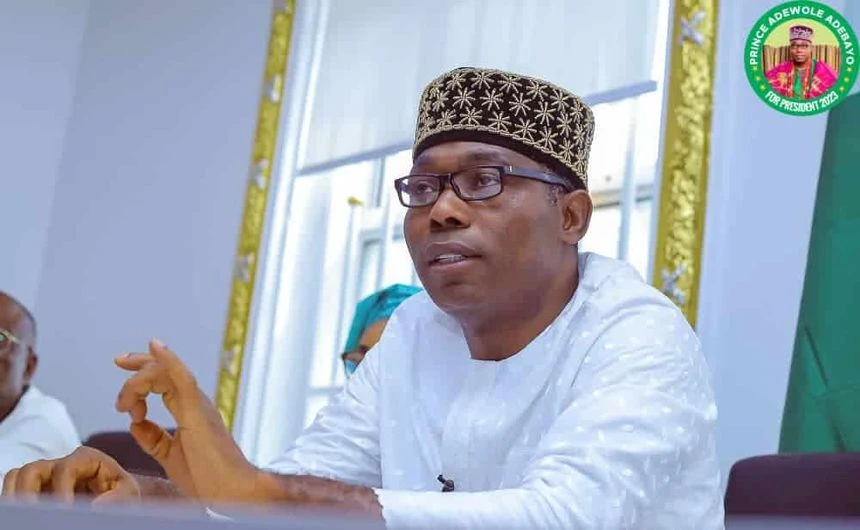
The presidential candidate of the Social Democratic Party (SDP) for the 2027 general election, Prince Adewole Adebayo, has accused President Bola Tinubu of using poverty and economic hardship as tools to weaken Nigerians and discourage them from demanding accountability from government.
Speaking during an interview on the state of the nation, Adebayo argued that the widespread suffering across the country is not accidental but a direct result of the policies and governance failures of the All Progressives Congress (APC)-led administration.
According to him, millions of Nigerians have become so consumed by the struggle for survival that they have lost sight of the rights and privileges that come with citizenship.
Follow PenTalk News
Get breaking news, important updates and the latest stories directly on your phone.
“The poverty that Nigerians are facing is artificial, government-inflicted and self-tolerated by the people,” he said.
Adebayo maintained that rather than empowering citizens through quality education, economic opportunities and effective social welfare programmes, the government has created conditions that keep people dependent on political patronage and handouts.
He argued that a population burdened by hunger and hardship would naturally find it difficult to challenge authority or demand constitutional guarantees from elected leaders.
“My opponent is not Tinubu,” he said. “My opponent is the ignorance of the people. Once they understand what the government is supposed to do and what their rights are as citizens, they will know why they are suffering.”
The SDP chieftain further alleged that the Tinubu administration has failed to uphold the principles of governance outlined in Chapter Two of the Constitution, which defines the responsibilities of government toward citizens.
According to him, proper management and deployment of public resources in line with constitutional provisions would significantly reduce poverty, unemployment and social dislocation.
Adebayo cited the growing number of out-of-school children as evidence of what he described as the government’s failure to fulfill its core responsibilities.
“There is no part of Nigeria where you will not find children selling on the streets or begging. Some receive no schooling at all, while others receive schooling without education,” he said.
He also accused the APC government of allowing the education sector to deteriorate to the extent that it produces graduates who are ill-prepared to contribute meaningfully to national development.
The SDP leader warned that an inadequately educated population is easier to manipulate politically and less likely to hold leaders accountable.
He further accused the government of diverting public attention from critical national issues while insecurity, unemployment and economic hardship continue to worsen.
According to him, prevailing economic conditions have created a society in which citizens are more inclined to accept temporary relief and political gifts than demand lasting reforms and good governance.
Adebayo argued that such a situation benefits politicians who exploit poverty to secure loyalty and suppress public scrutiny.
He stressed that the solution lies in political enlightenment and civic education, urging Nigerians to better understand the meaning of citizenship and the obligations government owes them.
“Politicians are looking for voters, but citizens should first understand that they are citizens and what that means. Once they understand their rights, they will stop settling for crumbs and start demanding good governance,” he said.
He maintained that meaningful political change would only occur when Nigerians reject what he described as a culture of dependency and begin holding leaders accountable for the nation’s vast resources and opportunities.
Adebayo added that the task before opposition parties and reform-minded leaders goes beyond defeating President Tinubu at the polls, insisting that citizens must be awakened to their constitutional rights and responsibilities.
According to him, Nigeria’s democratic and economic fortunes would improve once citizens become politically conscious and refuse to be controlled through poverty and patronage.