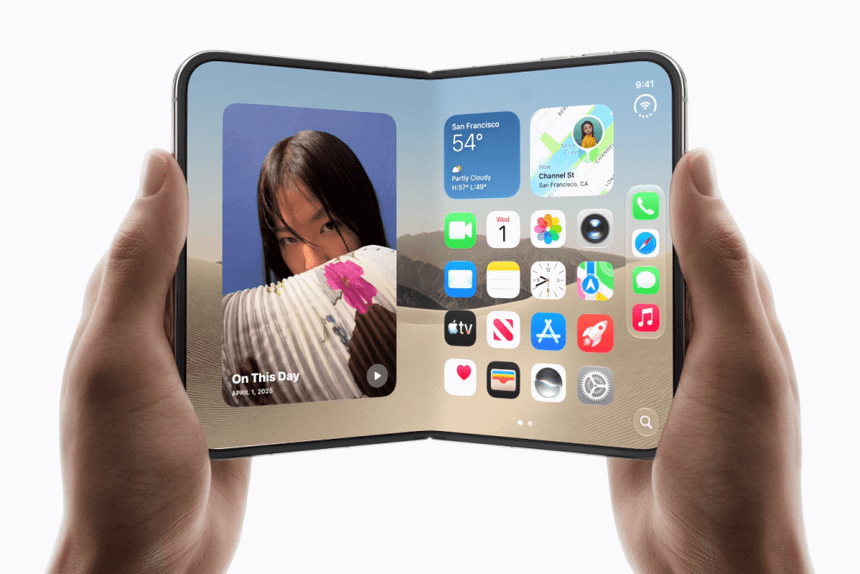
Apple has officially entered the foldable smartphone market with the launch of its first foldable iPhone, the iPhone Duo, unveiled at the company’s much-anticipated launch event on Wednesday.
The device, introduced by Apple executive John Ternus, comes with a book-style design and rounded edges. It unfolds horizontally to reveal a 7.6-inch internal display, while a smaller screen on the outside allows users to continue using the phone without opening it.
Apple described the iPhone Duo as its thinnest iPhone ever when fully unfolded. The device also brings Apple Pencil support to the iPhone for the first time, giving users a larger screen for writing, drawing and other productivity tasks.
Ternus described the iPhone Duo as an entirely new iPhone experience while emphasising that it retains the familiar design elements associated with Apple’s smartphones.
When opened, the foldable offers the largest display ever fitted to an iPhone. Its 7.6-inch internal screen provides about 80 per cent more display space than the iPhone 18 Pro.
The outer screen is approximately 90 per cent the size of the iPhone 18 Pro’s display. This allows users to carry out everyday tasks such as messaging, browsing and checking notifications without unfolding the device.
Apple said the hinge has been specially engineered to keep the internal screen flat when the phone is opened. It also provides controlled movement when the device is being folded or unfolded.
The iPhone Duo is powered by Apple’s A20 Pro chip, the same processor used in the iPhone 18 Pro and iPhone 18 Pro Max. It also features a 48-megapixel camera and comes in two colour options: Star White and Night Sky.
The foldable smartphone has a titanium body and uses separate battery units positioned on either side of the folding mechanism. Apple claims the device can provide up to 24 hours of battery life when the two screens are used equally.
Its fast-charging system can take the battery to 50 per cent in approximately 20 minutes. Apple also says a five-minute charge can provide up to five hours of video playback when using the outer display.
Unlike recent iPhone models that rely on Face ID, the iPhone Duo uses a fingerprint sensor built into the side button for authentication. The device is also being offered as an eSIM-only smartphone worldwide.
Apple is also promoting the foldable as a productivity device. With Apple Pencil support, users can take notes, sketch and interact with content on the larger internal display.
Another major feature of the iPhone Duo is Apple’s new C2 modem, the company’s second-generation in-house cellular modem.
The move represents another step in Apple’s efforts to reduce its dependence on Qualcomm, which has supplied cellular modem technology for many of the company’s smartphones.
According to Apple’s chief hardware officer, Johny Srouji, the C2 modem is up to 50 per cent faster than the previous generation while consuming 15 per cent less energy.
The modem also supports 5G mmWave connectivity in the United States. Apple said artificial intelligence is used to improve cellular reliability, including helping the device reconnect more quickly in areas with poor network coverage.
iPhone Duo Price and Availability
Apple has set the starting price of the iPhone Duo at $1,999 in the United States.
The company has not announced an official Nigerian retail price for the device. However, the phone is expected to cost well above ₦2 million in Nigeria, depending on the exchange rate, taxes, import costs, retailer margins and other local charges.
Apple will begin taking pre-orders from October 16, with the first sales scheduled to start on October 23 in more than 70 countries and regions.
The initial markets include the United States, United Kingdom, China, Japan, Australia, Canada, France, Germany, Singapore, the United Arab Emirates and other territories.
A further 28 countries and regions are expected to receive the device from October 30.
Apple’s arrival in the foldable smartphone market comes several years after rivals such as Samsung Electronics and Huawei Technologies established themselves in the category.
Although foldable phones remain a relatively small segment of the global smartphone market, Apple’s entry could give the category a significant boost.
International Data Corporation has projected that Apple could capture roughly 40 per cent of the global foldable smartphone market by the end of next year, highlighting the potential impact of the company’s first entry into the segment.