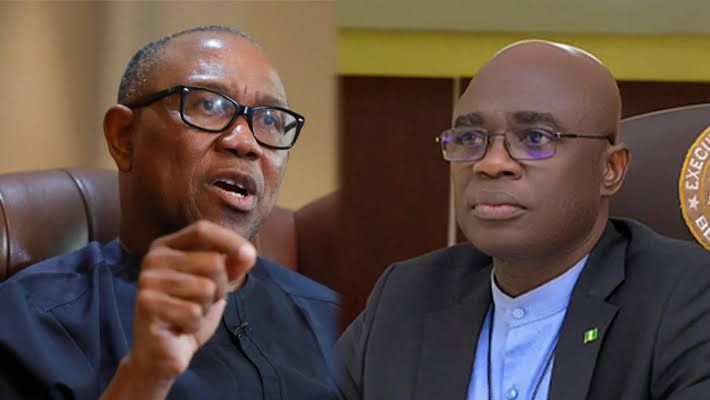
A planned visit by the presidential candidate of the Nigeria Democratic Congress (NDC), Peter Obi, to Yelwata in Benue State was disrupted on Tuesday after a group of youths blocked his convoy in Makurdi.
The development triggered a war of words between Obi and the Benue State Government, with both sides offering different explanations for the incident.
Obi said he travelled to Benue to sympathise with families who lost loved ones during the deadly Yelwata attack in June 2025. He alleged that youths had been mobilised by a government aide to stop him from reaching the community.
Follow PenTalk News
Get breaking news, important updates and the latest stories directly on your phone.
The state government, however, rejected the allegation, saying Obi failed to formally notify the authorities about his movement. It also accused the former Anambra State governor of attempting to turn the incident into a political controversy.
The Yelwata attack occurred between June 13 and 14, 2025, and reportedly left more than 200 people dead while several homes and properties were destroyed.
The police confirmed that they were aware of Obi’s planned movement and had deployed officers to provide security for the visit. The command said it was investigating the circumstances surrounding the roadblock.
The incident took place along Gboko Road, close to the Nigerian Air Force Base and Makurdi Airport. The youths reportedly barricaded the road while chanting, “We don’t want Peter Obi.”
The blockade disrupted traffic for several hours and eventually forced Obi’s convoy to return towards the airport. He later travelled to Jos, Plateau State.
Obi had arrived in Benue as part of a humanitarian visit to Yelwata, where families were still dealing with the aftermath of the 2025 massacre.
Speaking at the scene in a video shared by News Central Television on X, Obi said he was informed that some youths had been organised to prevent him from reaching the community.
He expressed disappointment over the development, arguing that young people who were themselves affected by poverty and insecurity should not be used for political purposes.
Obi maintained that his visit was strictly humanitarian and that the authorities had been informed of his plans.
The former governor said he wanted to meet relatives of those killed in Yelwata and identify with the community over the tragedy.
The NDC governorship candidate in Benue State, Prof. Terhemba Shija, said the party had informed security agencies about Obi’s visit.
According to him, the police and Department of State Services deployed personnel to accompany the presidential candidate.
Shija insisted that the visit was not a campaign rally but an opportunity for Obi to sympathise with victims of the Yelwata attack.
He argued that with the Independent National Electoral Commission having lifted restrictions on political activities, Obi had the right to move around the country.
The NDC candidate questioned why a presidential candidate should be stopped from visiting bereaved families after the relevant security agencies had been notified.
Shija described the incident as an indication of political anxiety and said there was no justification for preventing Obi from visiting the affected community.
Benue Government Denies Involvement
The Benue State Government denied organising or sponsoring the youths who blocked Obi’s convoy.
The Commissioner for Information and Orientation, Solomon Iorpev, said the government had not received an official notification concerning Obi’s visit.
He argued that Obi, as a former governor and presidential candidate, should have formally written to the state government so that appropriate security arrangements could be made.
Iorpev said the government had a responsibility to protect high-profile visitors but could not effectively do so without prior information about their movements.
He also said he could not identify the youths responsible for the blockade.
According to him, the incident might have coincided with the movement of youths from various parts of the state, but he stressed that he had no information linking them to the government.
The governor’s Chief Press Secretary, Kula Tersoo, also rejected the allegations against Governor Hyacinth Alia.
Tersoo described Obi’s claims as unfounded and suggested that the former governor was attempting to drag the state government into an internal political disagreement.
He said the Alia administration had no reason to prevent Obi from visiting Benue and maintained that the government did not rely on political thugs to maintain order.
The governor’s aide said genuine security concerns surrounding a presidential candidate would ordinarily be handled by recognised security agencies.
He urged the public to disregard claims linking the governor to the roadblock and said the state remained open to political actors and other visitors who came peacefully.
The police account, however, differed from the state government’s assertion that authorities had not been informed.
The Benue State Commissioner of Police, Cletus Nwadiogbu, confirmed that the command had received information about Obi’s visit.
He said he instructed the Assistant Commissioner of Police in charge of Operations to personally lead the officers assigned to provide security for the presidential candidate.
Nwadiogbu said officers were already handling the situation when the youths blocked the road.
He described Obi as a responsible individual and said the police were determined to establish why the youths decided to stop his convoy.
The command’s spokesperson, DSP Peter Aondongu, also confirmed that the police were aware of Obi’s movement to Yelwata.
He said security personnel were deployed for the trip but added that the motive behind the blockade remained unclear.
The police spokesperson said an investigation had commenced and that further information would be released as developments emerged.
After leaving Benue, Obi travelled to Plateau State, where he visited communities affected by attacks and met internally displaced persons.
Speaking in Mangu Local Government Area, he criticised the continued displacement of residents and said the existence of IDP camps reflected the failure to adequately protect citizens.
Obi said his visit was not about campaigning but about identifying with Nigerians forced away from their ancestral homes by insecurity.
He urged the Federal Government to intensify efforts to end killings, kidnappings and attacks in Plateau, Benue and other affected parts of the country.
While acknowledging the importance of prayer, Obi said government had the responsibility to protect citizens and ensure that those responsible for attacks were brought to justice.
He expressed concern over the number of people displaced by violence in Plateau, putting the figure at about 45,000 residents from more than 20 communities.
He also highlighted the impact of insecurity on education, noting that attacks had forced many children out of school.
Obi said he had visited affected communities several times and had supported interventions including water provision and school construction.
He told displaced residents that his hope was to see them eventually return to their communities and rebuild their lives.
The Peoples Democratic Party (PDP) governorship candidate in Benue State, Chief Michael Aondoakaa, also condemned the incident.
Aondoakaa described the obstruction as an attack on democratic values and the constitutional right of citizens to move freely within Nigeria.
In a statement issued by his media aide, James Ian, the former Attorney-General of the Federation said political affiliation should not determine whether a Nigerian could access any part of the country.
He urged political parties and their candidates to engage in peaceful competition ahead of the 2027 general election.
Aondoakaa also referenced the political peace agreement signed by parties and candidates, saying its principles included non-violence, issue-based campaigns and respect for political opponents.
He called for an impartial investigation into the incident and urged security agencies to identify and prosecute anyone found responsible.
He further cautioned against portraying the actions of a few individuals as representative of the entire Benue population.
NDC Demands Investigation
The NDC also demanded an immediate investigation into the incident.
The party’s National Publicity Secretary, Osa Director, described the blockade as disturbing and said Obi’s intention had been to sympathise with families affected by the Yelwata massacre.
The party said the failure to reach the community would not discourage its humanitarian engagements.
It called on the Benue Government and security agencies to investigate the incident, identify those responsible and ensure that political leaders and ordinary citizens could move freely.
The party said protecting lives remained one of the fundamental responsibilities of government.
Tambuwal Backs Obi
Former Sokoto State Governor Aminu Tambuwal condemned the obstruction in a statement shared on X.
Tambuwal said preventing Obi from moving around the country was unacceptable and inconsistent with democratic principles.
He stressed that Obi, like every other Nigerian, had a constitutional right to move freely and participate in lawful political activities.
With political activities already underway ahead of the 2027 elections, Tambuwal said all candidates should be allowed to travel, meet citizens and campaign without intimidation.
He urged the Inspector-General of Police and other security agencies to investigate the incident and ensure that anyone found responsible faced the law.
According to him, political disagreements should be settled through ideas, policies and programmes rather than intimidation or violence.
The National Electoral Accountability Consortium (NEAC) and Tap Initiative for Citizens’ Development also called for an investigation.
The organisations said reports and videos from the scene showed individuals blocking the road and moving towards vehicles in Obi’s convoy.
However, they stressed that the identities and motives of those involved had not been established.
The groups said political differences should not be allowed to become a justification for violence or intimidation.
They urged the Nigeria Police Force and other security agencies to conduct a prompt, impartial and transparent investigation.
They also called for the prosecution of anyone found to have committed an offence.
Previous Dispute
The latest disagreement is not the first controversy involving Obi and the Benue State Government over a proposed visit.
In April 2025, Obi claimed that he had been prevented from visiting Benue for humanitarian reasons.
The renewed dispute comes as political parties intensify preparations for the 2027 general election.
With INEC having lifted restrictions on political activities, parties and candidates are increasingly holding consultations, mobilising supporters and visiting communities across the country.
The incident in Benue has consequently raised fresh concerns about political tolerance, freedom of movement and the conduct of political activities as the country moves closer to the 2027 elections.