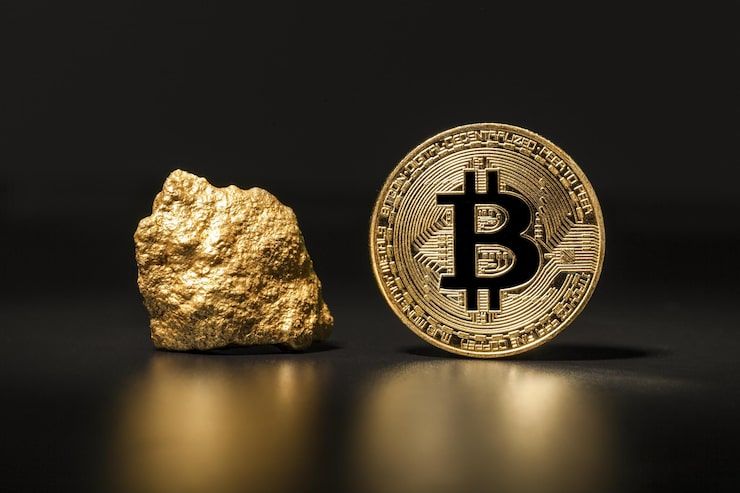
Gold and Bitcoin have recently moved in the same direction, an unusual development for two assets that typically attract investors for very different reasons.
Gold is traditionally viewed as a safe-haven asset. Investors often turn to it when economic or geopolitical uncertainty increases. Bitcoin, meanwhile, has generally benefited when investors are willing to take on greater risk and bet on higher returns.
Their simultaneous gains, therefore, have caught the attention of financial markets.
Follow PenTalk News
Get breaking news, important updates and the latest stories directly on your phone.
The common factor appears to be growing concern over the value of money.
US government debt has climbed beyond $40 trillion, while inflation remains a concern and questions about the long-term strength of the US dollar continue to influence investment decisions.
As a result, some investors have been moving part of their wealth into scarce assets whose supply cannot simply be increased by governments.
Andreas Anthis, head of multi-asset and absolute return at Mashreq Capital, explained that assets with limited supply tend to become more attractive when confidence in a currency’s purchasing power weakens.
Gold production can only increase gradually through mining, while Bitcoin has a fixed supply mechanism built into its design.
That combination helped attract investors to both assets as concerns grew around inflation, government borrowing and the future purchasing power of traditional currencies.
Gold moved above $4,600, while Bitcoin climbed past $80,000 for the first time since May.
But the market has since changed direction.
Why the Dollar Is Recovering
The latest shift has been partly linked to developments in the Middle East and the resulting increase in oil prices.
Higher oil costs could put additional pressure on inflation. If price pressures remain elevated, the US Federal Reserve could maintain higher interest rates for longer or potentially tighten monetary policy further.
Higher US interest rates can make dollar-denominated investments more appealing because investors can earn better returns from cash and bonds.
The dollar has consequently strengthened, while gold has fallen towards $4,300 and Bitcoin has slipped below $77,000.
Tony Hallside, chief executive of STP Partners in Dubai, said the earlier gains in gold and Bitcoin reflected a broader concern among investors about the purchasing power of money and the sustainability of government finances.
The Dollar Debasement Trade
The movement is closely associated with what financial markets call the “dollar debasement trade”.
The strategy involves reducing exposure to the US dollar and government bonds while increasing holdings of assets considered harder to create, including gold and Bitcoin.
However, Hallside cautioned against assuming that the two assets offer identical protection.
Gold has been used as a store of value for centuries and continues to receive substantial demand from central banks. Bitcoin, although deliberately scarce, remains considerably more volatile.
During periods of severe market stress, Bitcoin can behave more like a conventional risk asset than a defensive investment.
For that reason, Hallside believes the popular description of Bitcoin as “digital gold” should be treated carefully. Bitcoin has some similarities with gold, but its ability to provide consistent protection during market downturns has yet to be established across different market cycles.
The difference between the two assets can nevertheless be useful to investors.
Because gold and Bitcoin can respond differently to changing market conditions, owning both may provide greater diversification than concentrating entirely on one.
Higher Rates Change the Equation
For now, however, both assets are under pressure.
The recent reversal suggests that the dollar debasement trade has temporarily lost momentum as investors reassess the outlook for interest rates.
One disadvantage shared by gold and Bitcoin is that neither generates interest, dividends or other regular income.
That matters less when interest rates are close to zero. But when investors can earn around 5% or 6% from cash and bonds, holding assets that produce no income becomes less attractive.
Fawad Razaqzada, a market analyst covering global macro at Forex.com, said concerns that the Federal Reserve could adopt a more aggressive approach have reduced investors’ willingness to take risks.
That has contributed to declines across global stocks, gold and Bitcoin.
The US dollar, meanwhile, has regained its appeal as a haven.
Is Talk of a Dollar Collapse Overstated?
Recent predictions of an imminent collapse in the US dollar may have been exaggerated.
Madhur Kakkar, chief executive of Elevate Financial Services, argues that although the gradual erosion of the dollar’s influence is a legitimate issue, it is unlikely to happen quickly.
Investors who have positioned themselves for a dollar collapse have repeatedly been disappointed over the past decade.
The dollar has faced challenges from rival currencies before and has continued to maintain its leading position in the global financial system.
Vaibhav Loomba, group head of FX and rates at Klay Group, pointed to the euro’s introduction in 1999 as an example.
The dollar subsequently experienced a major cyclical decline, losing about 40% of its value over the following decade. Despite that fall, it remained the world’s dominant reserve currency.
According to Loomba, concerns about the dollar losing its influence have repeatedly resurfaced.
The currency does face several short-term pressures, including America’s growing debt burden and uncertainty surrounding its trade policies.
However, the US retains major advantages.
The size of its economy, its dominant technology industry and its importance to international trade continue to support demand for the dollar. Higher interest rates compared with many other developed economies also provide support through carry-trade strategies.
Investors Face Another US Risk
There is another issue investors need to consider: exposure to the dollar is often accompanied by significant exposure to US equities.
The enormous gains recorded by a small number of technology giants have pushed US stocks to account for approximately 60% of global market capitalisation, according to Hamza Dweik, head of trading for the MENA region at Saxo Bank.
When a relatively small group of companies contributes a large portion of market returns, portfolios can become heavily concentrated.
Dweik said investors are gradually reassessing the idea of US exceptionalism.
America’s large fiscal deficit, rising debt, trade disputes and political uncertainty are encouraging some investors to look beyond US assets.
He expects the US share of global investment portfolios to decline gradually as central banks diversify their reserves, international trade becomes less dependent on a single currency and investors search for opportunities elsewhere.
The dollar remains the world’s leading currency, but its dominance is no longer being accepted without question.
Darren Clarke, a trader at Lunaro Financial Services, also warned against becoming too dependent on US markets.
The strong performance of America’s biggest technology companies, particularly the so-called Magnificent Seven, has left many investors with significant exposure to US assets even when they did not deliberately build such concentrated positions.
Diversification could therefore become increasingly important.
European and Japanese equities, emerging-market assets and UK companies with reliable dividend payments could all provide investors with alternatives to an overwhelmingly US-focused portfolio.
Balance May Matter More Than Chasing Gains
The same principle applies to gold and Bitcoin.
Rather than rushing into assets after they have already posted large gains, investors may be better served by maintaining a balanced allocation that reflects their risk tolerance and investment objectives.
Anthis of Mashreq Capital believes both gold and Bitcoin can play a role in a diversified portfolio, although investors should recognise that neither is risk-free.
Bitcoin, in particular, can experience sudden and significant reversals.
Although gold and Bitcoin have recently moved together, their performance over longer periods can be very different.
Anthis noted that over the previous 12 months, gold had recorded substantial gains while Bitcoin had declined.
That divergence suggests that owning both does not necessarily mean simply doubling exposure to the same trade.
For investors, the latest market moves offer another reminder that momentum can change quickly.
Gold and Bitcoin may be under pressure today as the dollar strengthens, but the underlying concerns about US debt, inflation and the long-term purchasing power of currencies have not disappeared.
The $40 trillion-plus US debt burden continues to grow, meaning the debate over dollar debasement is unlikely to disappear.
If market conditions change again, gold and Bitcoin could regain momentum, and the next time, they may once again move in the same direction.
Source: The National. This report has been independently rewritten and edited by ED Mic