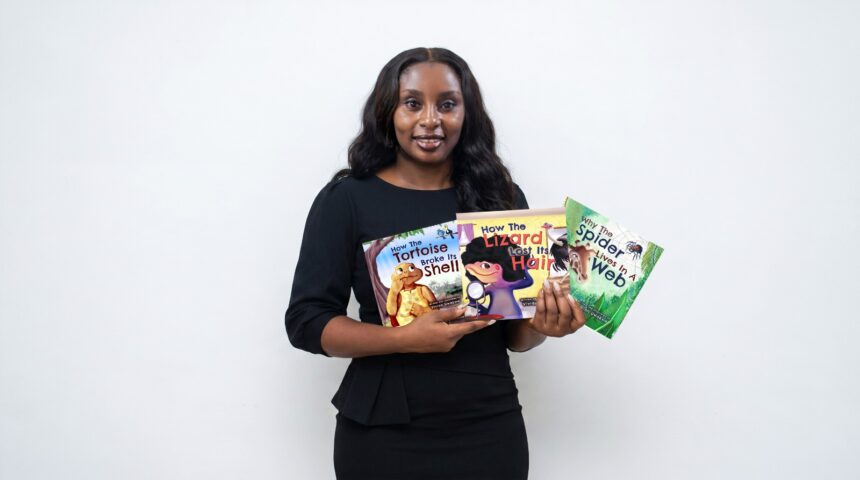
For Nigerian author, illustrator and storyteller, Vivian Uwakwe, a child’s identity is not something that should be left to chance. It is something that must be nurtured, protected and celebrated, including in the books the child reads.
Uwakwe believes that when children repeatedly encounter stories dominated by foreign characters, names, settings and cultural references, they may gradually begin to view their own heritage as less valuable.
“If you lose your identity, you lose something fundamental about yourself,” Uwakwe said.
Her conviction has become one of the driving forces behind her work as a children’s author and publisher through Yanga Toons, a brand committed to creating illustrated books that draw from African culture while maintaining standards that can compete internationally.
For Uwakwe, representation in children’s literature goes beyond placing an African name or face on the cover of a book. It is about giving children the confidence to recognise themselves, their communities, their experiences and their heritage as worthy of being documented.
“When a child’s heritage is represented in a book, the child receives a powerful message: I am important. My story is valuable, people like me belong in books,” she said.
Her passion for African representation is deeply rooted in her upbringing.
Uwakwe grew up in what she described as an unconventional home, surrounded by creativity and storytelling. Her father, an artist and storyteller, worked from home, giving her and her siblings unusual access to his creative world.
As a toddler, she was so fascinated by art that whenever she became unusually quiet, her mother knew she was probably in her father’s studio.
Yet, ironically, the same father who nurtured her artistic abilities discouraged her from pursuing art professionally.
Having experienced the financial challenges associated with working as an artist, he wanted his children to pursue careers that offered greater financial security, Uwakwe listened.
She studied science in secondary school, obtained a degree in management, ventured into banking, earned a master’s degree in the United Kingdom and later moved into consulting. But the creative gift never disappeared.
“No matter how long I stayed away from pen and paper, whenever I returned to it, it felt as though I was simply continuing from where I stopped,” she recalled.
Her return to writing and illustration eventually came through an unexpected encounter with a six-year-old child who could barely write the alphabet.
Concerned about the child’s learning difficulties, Uwakwe began creating customised learning materials. What started as an effort to help one child gradually evolved into Yanga Toons, a children’s publishing brand producing illustrated stories and activity books rooted in African culture.
The experience also helped her realise the power of children’s literature to influence not only literacy but character, imagination and identity.
According to her, a well-written children’s story can sometimes achieve what repeated scolding and punishment cannot.
“A well-written children’s story can teach values more effectively than spanking, scolding or punishment because children internalise lessons through stories,” she said.
For Uwakwe, stories create room for children to observe characters, understand their decisions and consider the consequences without necessarily feeling as though they are being lectured.
She cited The Lizard Story, in which the central character becomes obsessed with maintaining his beautiful afro and begins hurting others in the process.
“Beneath that laughter is a lesson about selfishness, obsession and the consequences of pursuing something at the expense of others,” she explained.
That, she said, is one of the unique powers of literature.
The child does not merely receive an instruction. Instead, the child encounters a character, follows the story and begins to make connections between actions and consequences.
Uwakwe is also concerned about the declining reading culture among children at a time when smartphones, social media and digital entertainment compete aggressively for their attention.
She argues that Nigerian authors and publishers must understand the quality of content children are already consuming online.
“Today’s children are exposed to beautifully illustrated characters, high-quality animation and sophisticated visual storytelling on their screens,” she said.
“So, what makes us think a poorly illustrated book, printed on inferior paper, filled with unedited language, will compete for their attention? It will not.”
For her, improving children’s reading culture must therefore go beyond telling children to put down their phones and pick up books.
The books themselves must be good enough to make children want to pick them up.
At Yanga Toons, she said, she deliberately pursues high standards, from conceptualisation and writing to illustration, editing and printing.
She also rejects the notion that African stories must necessarily appear old-fashioned to qualify as authentic.
“When we published The Tortoise Story in 2023, I researched available African folktales and noticed that many had either limited illustrations or were written in language that was too dense for children,” she said.
Her approach is to preserve the flavour and essence of African storytelling while presenting the stories in contemporary language and compelling visual formats.
Thus, while The Tortoise Story is an African folktale, The Lizard Story was created using the template and flavour of an African folktale. The recently released Spider Story similarly draws from African folklore while presenting it through fresh language and bright illustrations.
“For me, the story can originate in Africa and still be globally relevant,” she said.
That philosophy is also reflected in the production of her books.
According to Uwakwe, Yanga Toons books are printed locally in Nigeria, with carefully selected printers in Diobu, Port Harcourt.
She also places strong emphasis on editing, noting that no publication leaves the company without being reviewed.
“A children’s book deserves a second pair of eyes, and preferably an expert second pair of eyes,” she said.
Her ambition, she added, is not merely to produce books that Nigerian children can read, but books that can comfortably sit beside international titles on any bookshelf.
The author’s regular visits to schools have further strengthened her conviction that Nigerian children are eager to read and create when given the opportunity.
In almost every school she visits, she said, she encounters children who have written stories or even entire books, sometimes before they are 10 years old.
She is also fascinated by the questions children ask during book readings.
“They don’t just listen; they continue the story in their minds,” she said.
A child may question why a character made a particular decision or suggest a different ending. To Uwakwe, such questions reveal imagination at work.
She encourages the children to write down their ideas.
Her greatest satisfaction comes when children ask when her next book will be released.
“When a child finishes one book and wants the next, that is a powerful affirmation that the story has connected with them,” she said.
But while she sees tremendous potential among Nigerian children, Uwakwe believes the publishing industry needs greater support.
She wants author visits to become a regular feature of school activities and advocates stronger systems for selecting books used in classrooms.
According to her, schools should have review panels involving teachers, parents and relevant experts to assess children’s books based on quality, age-appropriateness, language, illustrations and educational value.
She also believes government and corporate organisations have important roles to play in building a stronger children’s publishing ecosystem.
Uwakwe pointed to Leadway Assurance’s Pages to Places initiative, through which more than 100 copies of her books were purchased and distributed and she was supported to visit schools in Port Harcourt.
She wants more corporate organisations to adopt similar initiatives.
“Instead of simply donating money for a single event, organisations can engage local children’s authors to create quality books around issues relevant to their businesses, publish them and distribute them to Nigerian children,” she said.
Such partnerships, she argued, can simultaneously support literacy, preserve local storytelling, create opportunities for Nigerian authors and ensure that children have access to books that reflect their realities.
The funding challenge remains significant, particularly for independent publishers.
Uwakwe said she personally finances virtually every aspect of her publishing work, including writing, illustration, editing, software, printing, marketing, distribution and school visits. Yet she continues.
“I see my work as a vocation, not simply a business,” she said.
Her ultimate ambition is bigger than building a successful publishing brand.
She wants her books to continue serving children long after she is gone and hopes the royalties generated from her work can eventually support vulnerable children.
She also wants her work to challenge other Nigerian children’s authors and publishers to improve.
“If an author sees our books and says, ‘It can be done better,’ that would make me happy,” she said.
“I want them to go back to their drawing boards, redesign their books, improve their illustrations, strengthen their editing and produce work that Nigerian children deserve.”
For Uwakwe, the question of identity ultimately returns to something simple but profound: belonging.
A child who sees people, places, names and experiences familiar to him or her in a book is being reminded that his or her world matters.
And in a country blessed with diverse cultures, languages, histories and traditions, she believes there is no shortage of stories waiting to be told.
“We have all the tools we need today to create inclusive literature. There is no reason why our children should not see themselves reflected in the books they read,” she said.
Ultimately, Uwakwe hopes her work will become part of a much larger movement, one in which Nigerian and African children grow up not only as readers, but as confident creators who understand that their stories are worthy of being told.
“I want people to enjoy the shade of the palm tree I planted, even when I am no longer here,” she said.
“That, for me, is legacy.”