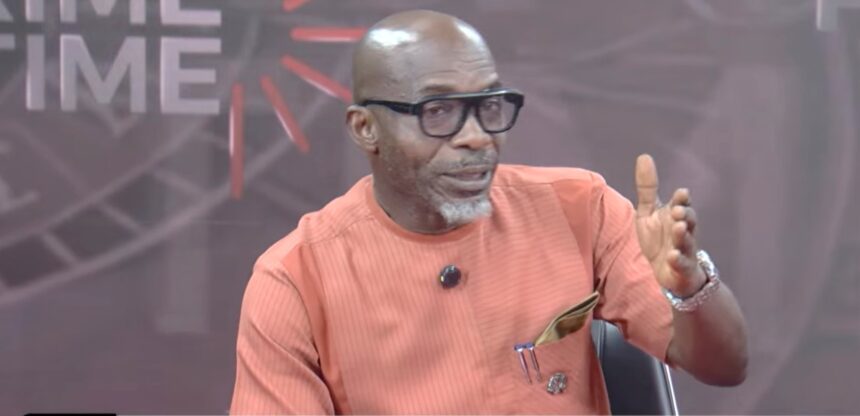
Dr Pedro Obaseki, a member of the African Democratic Congress (ADC) Presidential Campaign Council, has accused President Bola Ahmed Tinubu’s administration of worsening Nigeria’s economic situation, claiming that Nigerians are almost 700 per cent poorer since the president assumed office in May 2023.
According to ARISE News, Obaseki made the allegation during an interview on Monday while discussing the ADC’s plans for the 2027 general election and the economic challenges facing Nigerians.
His remarks followed comments by Kashim Ibrahim-Imam, chairman of the ADC Presidential Campaign Council, who said the party was prepared to rescue the country.
Follow PenTalk News
Get breaking news, important updates and the latest stories directly on your phone.
Obaseki argued that rising living costs and declining purchasing power had placed significant pressure on households across the country.
“Nigerians today are more or less almost 700% poorer than the way the day before the present administration of President Bola Ahmed Tinubu came into office,” he said.
He described the ADC’s proposed campaign as an effort to address what he called poverty of the pocket, poverty of the mind and the wider developmental challenges confronting Nigeria.
According to him, the party intends to prioritise affordability, economic welfare and policies that directly improve the lives of ordinary Nigerians.
The ADC chieftain also criticised the Tinubu administration over the rising cost of petrol and energy, arguing that the effects of economic policies had been felt across different regions and social groups.
He maintained that the government should be assessed based on its policies, performance and impact on household welfare rather than political declarations.
“What has the government of the day—the APC-led government of the day—done to the average Nigerian man?” Obaseki asked.
He argued that petrol prices, energy costs and other economic pressures had contributed to the difficulties experienced by ordinary Nigerians.
During the interview, Obaseki also referred to poverty estimates attributed to the International Monetary Fund (IMF) and the World Bank, citing figures he said reflected the scale of deprivation in the country.
However, his claim that Nigerians are almost 700 per cent poorer represents his assessment of the country’s economic situation and should not be treated as an independently verified national poverty statistic.
Obaseki also dismissed claims by the Minister of the Federal Capital Territory, Nyesom Wike, that he had secured the FCT and Rivers State for President Tinubu ahead of the 2027 election.
He argued that the economic experiences of voters would play a significant role in determining the outcome of the next presidential election.
According to him, political endorsements and declarations would not necessarily determine how Nigerians vote, particularly as households continue to contend with rising expenses.
Obaseki further criticised what he described as attempts to intimidate opposition supporters, insisting that the 2027 election should be decided by voters rather than political threats.
He cited a town hall meeting he moderated with former Vice President Atiku Abubakar in Benin City, Edo State, three days before the interview, saying the event took place peacefully.
The ADC chieftain maintained that Nigerians must move beyond political intimidation and focus on the issues affecting their daily lives.
ADC Projects Victory for Atiku Abubakar
Despite acknowledging divisions within the opposition, Obaseki expressed confidence in the ADC’s chances in the 2027 presidential election.
He projected that the party could win 24 states, disputing what he described as a lower internal projection attributed to its opponents.
Obaseki argued that political defections would not automatically determine the electoral map, maintaining that victory would depend on the party’s ability to secure sufficient votes across the federation.
He also defended the proposed presidential ticket involving Atiku Abubakar and Rotimi Amaechi, describing it as balanced and highlighting their political experience and national reach.
Obaseki further argued that Atiku’s economic proposals offered a policy-driven alternative to the current administration’s approach.
He said the ADC campaign intended to focus on practical solutions to Nigeria’s economic challenges, including petrol pricing and strengthening domestic production.
During the interview, Obaseki also revisited his account of an alleged abduction and assault in Benin City, Edo State.
He said he pursued the matter through various local and international institutions, including Amnesty International, the United Nations and the United States government.
According to him, he also worked with human rights lawyer Femi Falana and members of his family to pursue justice.
Obaseki said a ₦500 million judgment had been awarded in his favour but that he eventually agreed not to collect the money following an intervention by traditional institutions in Edo State.
He added that his decision was influenced by the discussions that followed the case and expressed hope that similar incidents would not occur again in the state.
Obaseki also dismissed concerns about possible violence during ADC campaigns in Edo, describing threats of intimidation as attempts to discourage opposition supporters.
He concluded by describing the 2027 general election as a defining moment for Nigeria and expressing confidence that Atiku Abubakar would emerge as the country’s next president.
The allegations and projections remain Obaseki’s political positions, while the eventual outcome of the election will depend on voters and the electoral process.