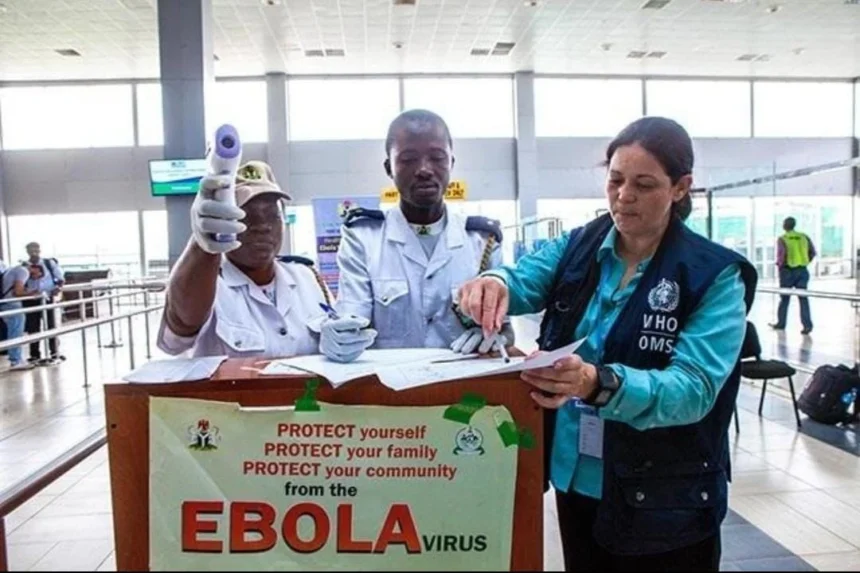
The Nigeria Centre for Disease Control and Prevention (NCDC) has expanded health declaration requirements for international travellers following the confirmation of an Ebola case in the Federal Capital Territory (FCT).
The Director-General of the agency, Jide Idris, disclosed this during a media briefing in Abuja on Sunday, October 25, 2026, explaining that the decision reversed an earlier restriction that applied the requirement only to travellers arriving from selected countries linked to Ebola transmission.
According to Idris, the measure initially covered international travellers before being limited to passengers arriving from countries including the Democratic Republic of the Congo (DRC) and Uganda.
Follow PenTalk News
Get breaking news, important updates and the latest stories directly on your phone.
However, following the confirmed case in Abuja, the agency decided to widen the requirement again.
Idris said the NCDC had issued advisories to the Federal Airports Authority of Nigeria (FAAN) and the Nigerian Civil Aviation Authority (NCAA) to facilitate implementation in collaboration with airlines.
NCDC Strengthens Airport Screening
As part of efforts to prevent further transmission, the NCDC is strengthening preparedness and screening at five international airports in Nigeria.
The airports are located in Lagos, Abuja, Enugu, Kano and Port Harcourt.
Idris explained that Port Health Services was working with aviation officials, immigration personnel and customs officers to improve surveillance and preparedness at the country’s points of entry.
He noted that effective implementation required cooperation among the relevant agencies because the NCDC does not independently control airport operations.
The agency also acknowledged operational challenges at the Lagos airport, where ongoing construction has reportedly affected some activities. Idris said discussions would be held with FAAN and the NCAA to address issues affecting Port Health Services.
53 Contacts Identified Following Confirmed Case
The expanded screening measures follow the confirmation of Ebola disease caused by the Bundibugyo virus in the FCT on October 20, 2026.
The patient was identified as a 42-year-old Ugandan woman who travelled to Nigeria from Uganda on October 3. According to the report, she developed symptoms shortly after her arrival and sought medical attention before the infection was confirmed.
At the briefing, Idris disclosed that health authorities had identified 53 primary contacts associated with the patient.
The contacts include 44 people linked to the health facility where she received treatment and nine others, including household members and individuals involved in her care and sample collection.
The NCDC said contact tracing was ongoing, with public health officials monitoring the identified individuals for possible symptoms.
Contacts to Be Monitored for 21 Days
Health authorities are following up with identified contacts for 21 days, which corresponds to the maximum incubation period for Ebola disease.
The monitoring process is intended to identify possible symptoms early and ensure that anyone who becomes ill receives prompt medical attention.
Idris urged people identified as contacts to cooperate with health officials, stressing that being listed as a contact does not mean an individual has contracted the disease.
The NCDC is also strengthening infection prevention and control measures in healthcare facilities, supporting laboratory capacity and intensifying public health communication to address rumours and misinformation.
The agency urged Nigerians to rely on verified information from authorised health authorities and cooperate with public health measures as investigations continue.
The situation remains under surveillance, with the effectiveness of contact tracing and other containment measures expected to play an important role in limiting the risk of further transmission.