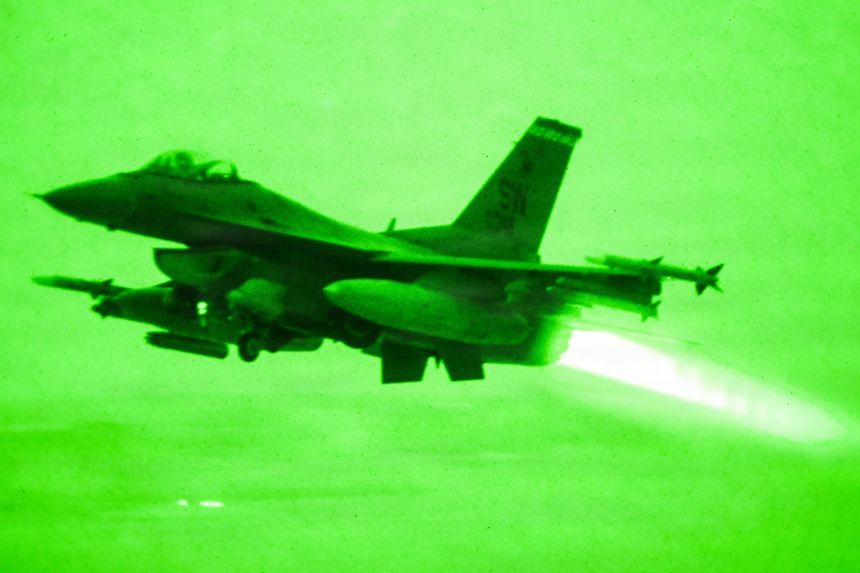
Iran launched missile and drone attacks against U.S. military positions in Kuwait on September 3, escalating tensions six months into the conflict despite fresh warnings from President Donald Trump that Washington could launch more strikes.
Trump said the United States retained the ability to attack Iran whenever it chose, following a series of heavy American bombardments that Iranian officials said had killed at least 19 people.
Tehran responded with attacks on U.S. military interests across the Middle East. Targets were reported in Kuwait, Jordan, the United Arab Emirates, Bahrain and Iraq’s autonomous Kurdistan region.
Follow PenTalk News
Get breaking news, important updates and the latest stories directly on your phone.
The latest escalation comes as the wider conflict remains deadlocked. Iran continues to exert control over the Strait of Hormuz, a crucial route for global oil shipments, while Washington maintains pressure on Iranian ports through its counter-blockade.
Iranian security official Mohsen Rezaei warned Washington that Tehran had adopted what he described as a new wartime strategy.
He said the strategy would “shatter your foundations.”
Kuwait’s military said it was working to intercept missiles and drones launched from Iran on September 3. Iranian state television confirmed the attacks, saying U.S. bases in Kuwait were being targeted in retaliation for what Tehran called American attacks against the Iranian people.
The latest phase of the conflict began on August 30, when the United States carried out strikes against Iranian targets. Washington said the operation was aimed at preventing Iran from laying naval mines in the Strait of Hormuz.
Iran said the August 31 attacks caused casualties and retaliated by targeting American forces stationed in Jordan and the United Arab Emirates.
The violence has also spilled into commercial shipping. Two oil tankers were hit in separate attacks whose perpetrators have not been identified, according to a Saudi shipping company. Two Filipino sailors were reportedly killed in one of the incidents.
Washington has also intensified its economic campaign against Tehran.
U.S. Energy Secretary Chris Wright said on September 2 that proposed sanctions against countries and businesses maintaining economic ties with Iran would create what he called “absolutely maximum pressure” on the Islamic Republic.
Trump also floated the idea of giving the Strait of Hormuz a new name, suggesting it could become the “Trump Strait.” He later appeared to indicate that the proposal was not meant seriously.
“Now that we have it under U.S.A. control, should we change the name Hormuz Strait to TRUMP STRAIT???” Trump wrote on Truth Social.
Iran’s latest attacks on American positions followed a U.S. strike in southern Iran that reportedly hit a wedding gathering, triggering strong condemnation from Iranian officials.
The Iranian Red Crescent said missile fragments killed four people in the coastal town of Kuhestak, including a child, while more than 50 others were injured.
The U.S. military did not directly comment on the reported strike.
Tim Hawkins, a spokesman for U.S. Central Command, said American forces do not deliberately target civilians and accused Iran’s Islamic Revolutionary Guard Corps of doing so.
Iran’s top negotiator, Mohammad Bagher Ghalibaf, condemned Washington over the incident and described the United States as “Satan.”
“If a power acts like Satan, picks targets like Satan, and kills like Satan, it’s Satan,” he wrote on X.
The reported civilian casualties have also fueled calls among Iranians for the fighting to end.
Hossein Moazami, a 50-year-old self-employed Iranian, described the renewed conflict as deeply troubling and urged both sides to resume negotiations.
He said ordinary Iranians were bearing the greatest burden of the war while Americans were largely removed from the immediate danger.
A video released by an Iranian government-linked account showed debris and damage at what was identified as the wedding location in Kuhestak. Screams could be heard in the footage.
Ali Mallahi, the bride’s father and owner of the damaged building, described the incident as deeply painful in comments broadcast by Iranian state television.
He said he was grateful that the number of casualties had not been higher.
Conflict Threatens Wider Regional War
The current war began on February 28 with U.S. and Israeli attacks on Iran that killed Supreme Leader Ayatollah Ali Khamenei.
A ceasefire later came under severe strain following attacks involving commercial vessels in the Strait of Hormuz, a waterway that previously carried roughly one-fifth of global oil supplies.
Meanwhile, Israel has warned that it is prepared to respond forcefully if Iran attacks during the Jewish high holiday period, which begins in mid-September.
Israeli Defence Minister Israel Katz said Iran was currently carrying out strikes across the region but had not directly targeted Israel.
“For now, they are striking throughout the region except us,” Katz said at a conference organised by Israeli media organisations.