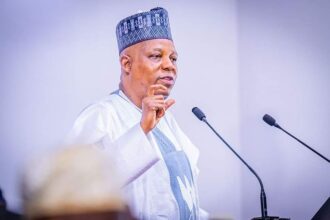
For years, many Nigerians on social media have alleged that former Kaduna State Governor Nasir El-Rufai was connected to the disappearance, since the incident occurred during his tenure.
Former Kano State Governor Abdullahi Ganduje has now urged closer examination of remarks made by his Kaduna counterpart, Nasir El-Rufai, after the latter linked him to the disappearance of Abubakar Idris, popularly known as Dadiyata.
In a statement issued through former Kano Commissioner for Information and Internal Affairs, Muhammad Garba, Ganduje dismissed the accusation as reckless and unfounded. He described it as an attempt to transfer blame for an incident that took place entirely within Kaduna State.
Follow PenTalk News
Get breaking news, important updates and the latest stories directly on your phone.
El-Rufai had earlier claimed that Dadiyata was abducted from his Kaduna residence by police officers allegedly sent from Kano while Ganduje was governor. However, for years, social media discussions have largely blamed El-Rufai, who governed Kaduna at the time of the abduction.
Speaking on Arise Television, El-Rufai stated that Dadiyata was not his critic, as widely believed, but rather a strong critic of Ganduje’s administration. He claimed that a police officer later confessed that officers were sent from Kano to carry out the abduction.
El-Rufai further argued that the case should not be considered a Kaduna State matter, despite the abduction happening there, saying Kaduna authorities were unaware of any dispute between Dadiyata and the Kano government.
Background on Dadiyata’s Disappearance
On August 2, 2019, Dadiyata, a lecturer at the Federal University Dutsin-Ma, was reportedly taken by armed men as he entered his residence in Barnawa, Kaduna State.
A prominent social media commentator and supporter of former Kano governor Rabiu Kwankwaso, his disappearance sparked legal action by his family and rights groups. In 2020, a Federal High Court ordered security agencies to produce or release him, but authorities denied holding him.
International rights groups later categorized the case as an enforced disappearance. More than seven years later, his whereabouts remain unknown, and no group has claimed responsibility.
Ganduje’s Full Response
Through Garba, Ganduje firmly rejected any connection to the incident, insisting the abduction occurred in Kaduna where Dadiyata lived and carried out his activities. According to the statement, the activist’s criticisms were primarily directed at the Kaduna government, not Kano authorities.
Garba argued that security responsibility at the time lay with Kaduna State and federal agencies operating there. He called for serious allegations to be backed with credible evidence rather than political statements.
He also contrasted Kano’s political environment under Ganduje with what he described as a more restrictive climate elsewhere, claiming Kano allowed open criticism without intimidation of journalists or opposition voices.
The statement further questioned why El-Rufai allegedly failed to formally report or pursue investigations after learning of a supposed confession by a police officer involved in the abduction.
Garba added that public discussions over the years have mainly focused on events within Kaduna, with several commentators raising concerns about how the case was handled.
While expressing sympathy for Dadiyata’s family, he stressed that the focus should remain on uncovering the truth through lawful and transparent investigations.
He warned against turning the tragedy into political blame games and urged anyone with reliable information to present it to security authorities so accountability can be established through due process rather than speculation.
— Muhammad Garba
Former Commissioner for Information and Internal Affairs, Kano State