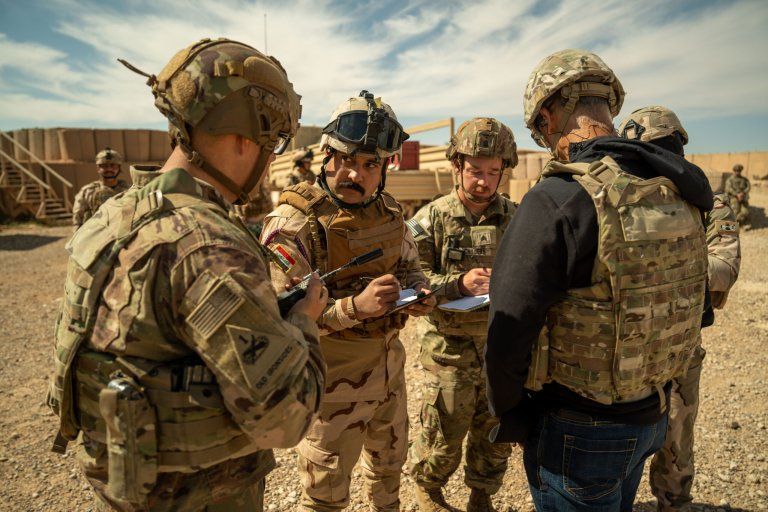
The United States is set to formally end its military mission in Iraq this week, completing a withdrawal that will bring to a close more than two decades of American military presence in the country.
The final deadline is September 30, 2026, when the US-led international coalition’s military headquarters in Iraq is scheduled to close. Iraqi officials say the country’s security forces now have control of the country’s territory and that there are no foreign military bases remaining on Iraqi soil.
The withdrawal marks the end of a military chapter that began with the US-led invasion of Iraq in March 2003, which toppled President Saddam Hussein. The American presence later changed significantly, with combat forces leaving in 2011 before returning three years later to help Iraq confront the rapid expansion of the Islamic State group, also known as ISIS.
Follow PenTalk News
Get breaking news, important updates and the latest stories directly on your phone.
From invasion to the fight against ISIS
At the height of the US-led counterinsurgency campaign in 2007, more than 170,000 American troops were deployed in Iraq.
The final US combat troops left in December 2011, but the military returned to the country in 2014 after ISIS captured large areas of Iraq and Syria. The Iraqi government invited the US-led coalition to assist in rebuilding and training Iraqi security forces and fighting the extremist group.
The coalition subsequently helped Iraqi forces regain territory held by ISIS. Although the group lost control of the major areas it once occupied, it has continued to exist as a reduced insurgent threat through scattered cells.
Coalition combat operations in Iraq ended in 2021, while American forces remained in smaller numbers to train Iraqi forces and conduct counterterrorism operations alongside them. Washington and Baghdad later agreed in 2024 on a two-phase plan to end the coalition’s military mission in Iraq.
Final withdrawal underway
The remaining US military personnel have been withdrawing from northern Iraq, particularly the semi-autonomous Kurdistan Region.
Hundreds of US troops were still in northern Iraq as the September 30 deadline approached. According to US officials cited by the Associated Press, most of those personnel are expected to be redeployed to Jordan and other locations in the region, while military equipment, including air defence systems, is also being removed.
The US State Department said on September 23 that Washington remained on course to complete the withdrawal by September 30 as part of the agreed transition away from Operation Inherent Resolve, the international campaign against ISIS.
Iraq has described the end of the coalition mission as a transition towards a new phase of relations with Washington, rather than the end of cooperation between the two countries.
Future cooperation is expected to include areas such as intelligence sharing, security coordination and military equipment programmes.
Questions over Iraq’s security after the withdrawal
The departure of American troops comes as Iraq also faces a separate dispute over the future of armed groups operating outside direct government control.
The Iraqi government has sought to bring weapons under state authority, but some powerful armed factions have rejected calls to surrender their weapons. The issue has become increasingly important as the US withdrawal approaches because some militias have previously cited the presence of American forces as a justification for maintaining their armed capabilities.
The withdrawal is also being closely watched in Iraq’s Kurdistan Region, where US forces have provided security assistance and where American positions have previously come under attack.
Iraqi officials have said they are working to strengthen the country’s air-defence capabilities, including through planned purchases from countries such as South Korea, Turkey and the United States.
A new phase in US-Iraq relations
The September 30 deadline therefore represents more than the departure of the final American troops. It marks a shift from a US-led military mission towards a bilateral relationship in which Iraq assumes primary responsibility for its internal security.
American and Iraqi officials have repeatedly said that the end of the military mission does not mean an end to relations between the two countries.
For Washington, the next phase is expected to rely more heavily on diplomatic, economic and security cooperation rather than a permanent military presence in Iraq.
For Baghdad, the withdrawal provides an opportunity to assert greater control over national security while maintaining cooperation with international partners against the remaining ISIS threat.
The closing of the coalition headquarters on September 30 will consequently end the US military mission in Iraq, but it will not end the broader relationship between Washington and Baghdad.
Source/credit: Associated Press, Iraqi News Agency and other reports. Report compiled by Michael Costa