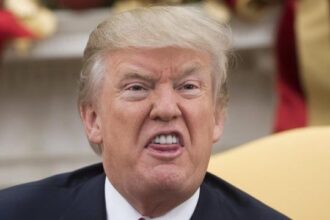
The United States President Donald Trump remains committed to ending the months-long conflict in the Middle East as soon as possible, according to Massad Boulos, his senior adviser on Arab and Middle Eastern affairs.
Speaking to Euronews at the Arab Media Summit in Dubai, Boulos said Trump was actively working towards ending the conflict but declined to provide a specific timeline.
According to Boulos, the decision on when the war should end would ultimately rest with Trump.
Follow PenTalk News
Get breaking news, important updates and the latest stories directly on your phone.
“The president believes that it’s going to end soon, and he’s determined to make it end. And he’s working towards that,” Boulos said.
He described Trump as a leader who follows through on his commitments, saying the president had demonstrated his willingness to fulfil promises made during his campaign and afterward.
When asked when the conflict could end, Boulos responded that the timing would be determined by Trump.
He added that the administration remained confident in the president’s approach and fully supported his leadership.
Boulos identified Iran’s nuclear programme as a central issue that must be addressed before the conflict can come to an end.
He reiterated the Trump administration’s position that Iran should not be allowed to acquire a nuclear weapon.
“Somebody had to tackle and had to address this nuclear issue,” Boulos said, adding that Trump was still giving diplomacy and negotiations an opportunity.
Boulos said the president had shown considerable patience during the process and expressed hope that diplomatic efforts would ultimately lead to peace.
He also said the administration remained determined to prevent Iran from obtaining a nuclear weapon, while stressing that countries in the region did not want a prolonged war.
Boulos referred to Trump as “the president of peace” and claimed that the US president had previously helped bring several international conflicts to an end.
He said Trump had resolved eight conflicts and was currently working to address two others.
Boulos also cited tensions between India and Pakistan, claiming that Trump’s efforts had helped prevent a significant loss of life. He did not provide further details about the conflicts he was referring to or substantiate the casualty figure he mentioned.
Boulos also discussed the Abraham Accords, the agreements that normalised relations between Israel and several Arab countries during Trump’s first presidency.
He said efforts to expand the agreements had been disrupted by the 2020 US election but could resume after the current conflict is resolved.
According to Boulos, additional countries had previously been prepared to join the initiative.
He said the administration wanted to return its attention to broader peace initiatives once the current crisis had been addressed.
Boulos also described Saudi Arabia, Egypt, Jordan, the United Arab Emirates and Qatar as important partners of Washington in the region.
He said relations between the US and those countries remained strong at both the leadership and working levels.
“These are true partners. They are true allies,” Boulos said, adding that Trump had developed strong personal relationships with several regional leaders.
He said coordination between Washington and its regional partners was taking place across multiple levels of government.
Asked about public sentiment towards Trump in the Middle East, Boulos pointed to what he described as shared views on family and social values.
Boulos, who said he had worked with Christian, Muslim and other communities during Trump’s political campaigns, argued that Trump’s socially conservative positions had attracted support among some Middle Eastern communities.
He said he had travelled extensively across the region and claimed that both leaders and members of the public had expressed support for Trump.
Boulos particularly highlighted Trump’s opposition to what his campaign described as “woke ideology”, saying some Middle Eastern communities shared those views.
Boulos identified Sudan as another major priority for the Trump administration, describing the country’s ongoing conflict as a severe humanitarian crisis.
He said Trump wanted the war in Sudan to end as quickly as possible.
According to Boulos, about 35 million Sudanese people require humanitarian assistance, while approximately 25 million are experiencing conditions he described as similar to famine.
He said the United States remained the largest humanitarian donor to Sudan, with more than $3 billion provided since the conflict began.
Boulos said Washington’s involvement had focused on humanitarian assistance and diplomatic efforts. He also pointed to US support for an arms embargo being pursued at the United Nations Security Council.
On American domestic politics, Boulos said Trump was actively campaigning ahead of the midterm elections.
He referenced a political convention held in Dallas, which he described as the first of its kind for a midterm election.
However, Boulos suggested that the conflict involving Iran would not necessarily be the main issue determining how Americans vote.
He said domestic concerns traditionally play a significant role in the priorities of US voters and would remain important during the midterm elections.
Source: Euronews