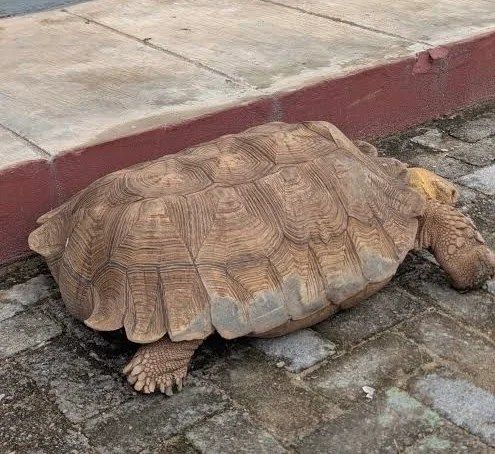
An ancient tortoise popularly known as Baba, which had for generations been associated with the Alaafin’s Palace in Oyo, has died.
Baba, whose age was traditionally estimated at about 420 years, reportedly died on Monday after falling ill and losing his appetite. He was subsequently buried, according to a statement issued by Bode Durojaiye, Director of Media and Publicity to the Alaafin of Oyo.
The tortoise’s death has attracted attention in Oyo because of the unusual place Baba occupied in the history and oral traditions surrounding the ancient Yoruba kingdom.
Follow PenTalk News
Get breaking news, important updates and the latest stories directly on your phone.
According to palace oral history, Baba was brought from Oyo-Ile, the old capital of the Oyo Empire, to the present-day Oyo town, where he became part of life at the Alaafin’s Palace.
Successive generations of Alaafins reportedly inherited responsibility for the tortoise, while palace officials helped care for it.
Over the years, Baba became more than an animal kept within the palace grounds. He was regarded by many residents as a living link to Oyo’s past and a reminder of the generations of traditional rulers who had occupied the throne.
The palace’s account places Baba’s history within a period stretching back several centuries. However, the reported age of about 420 years is based on traditional accounts rather than a documented scientific age assessment.
That distinction is significant because even exceptionally long-lived giant tortoises generally have lifespans measured in centuries only in rare cases. The Guinness World Records-recognised Jonathan, for example, is estimated to be at least 194 years old in 2026 and is currently recognised as the oldest known living land animal.
Baba’s remarkable age and gentle nature reportedly made him a curiosity for residents, visitors and people interested in Oyo’s history.
Those who visited the palace had the opportunity to see the ancient reptile, whose presence had become intertwined with stories about the Alaafin institution and the history of the town.
He was reportedly fed with a variety of foods, including watermelon, corn pap wrapped in leaves and grass.
His continued presence at the palace also gave visitors a tangible connection to a part of Oyo’s heritage that is largely preserved through oral history.
Oyo itself has a long association with historical sites and traditions connected to the old Oyo Empire. Academic and historical sources identify Oyo-Ile, also known as Old Oyo, as the former imperial centre from which traditions associated with the Oyo-Yoruba people trace their ancestry.
Another ancient tortoise in Oyo history
Baba’s story also recalls that of Alagba, the famous tortoise that lived at the palace of the Soun of Ogbomoso.
Alagba died in October 2019 after being widely described as a 300-plus-year-old tortoise. Contemporary reports placed its estimated age at about 344 years, although that figure, too, was based on historical accounts rather than a modern scientific birth record.
A 2017 account of tourism attractions in Oyo State also listed the palace of the Soun of Ogbomoso and its then-famous ancient tortoise among attractions associated with the state.
The stories of Alagba and Baba illustrate how long-lived tortoises have become part of the cultural memory and tourism history of traditional Yoruba palaces.
Baba remembered as part of Oyo’s cultural memory
For generations, Baba was regarded by many in Oyo as more than a palace animal.
His presence provided a connection between the present-day Alaafin’s Palace and stories passed down from earlier generations. The tortoise was said to have survived successive reigns and witnessed major changes in the community around the palace.
Durojaiye described Baba as “more than a turtle,” portraying his death as the loss of an enduring companion of the Alaafin and a creature deeply associated with Oyo’s cultural memory.
The Alaafin’s Palace has continued to emphasise its role as a custodian of Yoruba heritage. The current Alaafin, Oba Akeem Owoade, moved into the ancient palace in Oyo in January 2026 after extensive rehabilitation work, according to the palace’s media office.
Baba’s death therefore comes at a time when renewed attention is being paid to the historical significance of the ancient palace and its place in Oyo’s traditional institution.
His burial marks the end of an unusual chapter in the palace’s history.
Although the exact age attributed to Baba may remain part of oral tradition, his decades-long presence and the stories surrounding him had already made him a distinctive part of Oyo’s heritage.
For those who knew his story or visited him at the palace, Baba was not simply an old tortoise.
He had become a living reminder of the passage of generations.