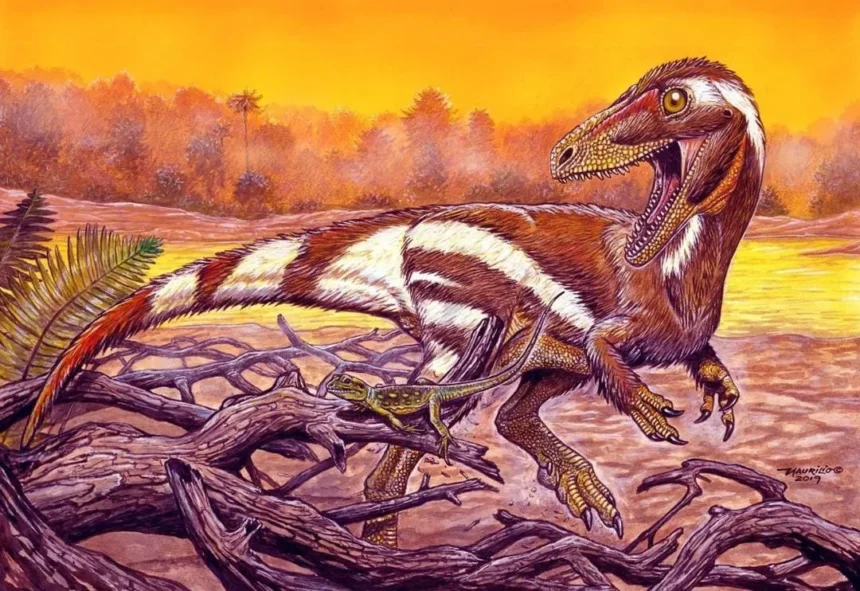
Scientists have reported finding microscopic structures resembling red blood cells, alongside chemical traces associated with blood, in the fossilised bones of a dinosaur that lived approximately 115 million years ago in what is now northeastern Brazil.
The discovery, described as a significant development in palaeontology, could help researchers better understand the biology of dinosaurs and how traces of biological material can survive for millions of years.
According to a study published in the journal Proceedings of the National Academy of Sciences (PNAS) on November 2, 2026, an international team of researchers examined limb bones belonging to Aratasaurus museunacionali, a meat-eating dinosaur that lived during the Cretaceous Period.
Follow PenTalk News
Get breaking news, important updates and the latest stories directly on your phone.
The fossil was originally discovered in 2008 at a gypsum mine in Ceará State, northeastern Brazil, before being preserved for further scientific examination.
What Scientists Found Inside the Dinosaur Bones
The researchers identified numerous tiny, oval-shaped structures inside microscopic channels in the bones that once carried blood vessels.
Using advanced imaging techniques and chemical analysis, the team detected heme-related molecules, including heme B, an iron-containing component associated with haemoglobin, the protein responsible for transporting oxygen in red blood cells.
The combination of the microscopic structures and the chemical evidence led the researchers to interpret the findings as mineralised remnants of ancient red blood cells.
Professor Kliti Grice of Curtin University in Australia, who led the research team, described the discovery as a landmark development in the study of ancient biological material.
The researchers believe that mineralisation involving a manganese oxide mineral called hausmannite may have helped preserve the structures and associated chemical traces.
Dinosaur Blood Was Not Recovered Intact
Despite the remarkable findings, the researchers stressed that they did not discover fresh dinosaur blood or completely preserved red blood cells.
Instead, the discovery involves mineralised structures and surviving chemical traces that appear to be associated with the dinosaur’s original blood.
The study also does not provide evidence that dinosaur DNA has survived in the fossil. Scientists say that the preservation of small molecules such as heme does not mean that larger biological materials, including DNA and intact proteins, have survived for the same period.
The distinction is important because the discovery does not bring scientists closer to cloning dinosaurs in the way portrayed in the Jurassic Park films.
Discovery Could Help Scientists Understand Ancient Life
Researchers believe the findings could open new opportunities for studying the evolution of blood, oxygen transport, metabolism and other biological processes in extinct animals.
The discovery may also encourage scientists to re-examine fossils already held in museums, using modern analytical techniques to search for chemical evidence that earlier investigations could not detect.
However, some outside experts have expressed caution about identifying the microscopic structures as red blood cells with certainty. While the chemical evidence has attracted interest, the precise interpretation of the cell-like structures remains a subject of scientific discussion.
The research nevertheless highlights how new scientific methods are expanding the information that can be extracted from fossils, potentially providing fresh insights into animals that disappeared millions of years ago.