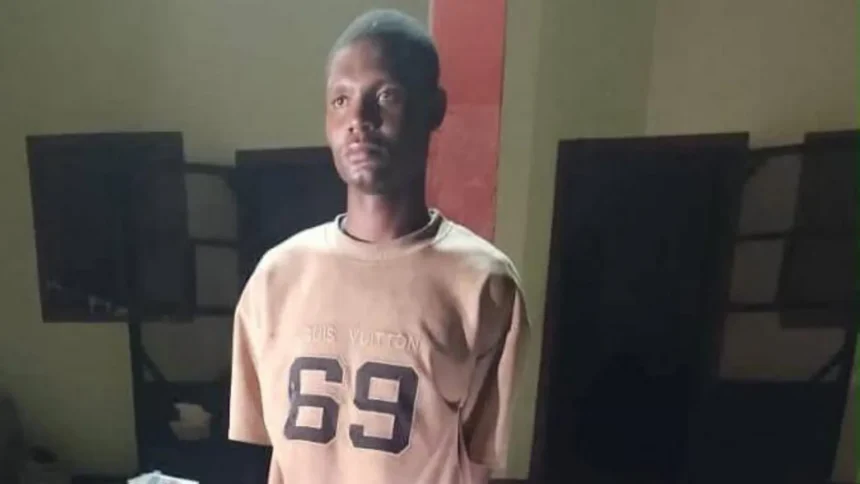
The Nigerian Army has arrested one of its personnel, Private Mohammed Yusuf, over allegations that he supplied military uniforms to armed criminal groups, including terrorists.
According to the Army, Yusuf was apprehended on Saturday evening at a bus stop in Maiduguri, Borno State. Military spokesperson Lt. Col. Mohammed Goni said the soldier was allegedly attempting to escape to neighbouring Cameroon after abandoning his duty post earlier this month.
Investigators said Yusuf, who had previously worked at a military equipment factory, went into hiding in Maiduguri with the assistance of an associate after deserting his unit. He has not publicly responded to the allegations.
The arrest has renewed public concern about possible collaboration between security personnel and criminal groups responsible for Nigeria’s worsening insecurity.
Armed groups, including Boko Haram, ISWAP, separatist fighters and kidnapping gangs, have frequently been seen wearing military uniforms during attacks, raising questions about how they obtain such equipment.
Security analyst and retired Army Major Bashir Galma said there have been cases where planned military operations were allegedly leaked to insurgents before they were carried out.
“There have been instances where information about planned attacks found its way to Boko Haram or other criminal groups,” he said, suggesting that insiders may have compromised military operations.
Insecurity Continues to Worsen
Nigeria continues to face serious security challenges, with thousands of people killed or kidnapped by armed groups.
Figures from the National Human Rights Commission indicate that between January 2024 and April 2025, more than 3,000 kidnappings and 3,500 killings were linked to armed groups across the country.
Mass abductions, particularly in northern Nigeria, have become increasingly common. Criminal gangs known as bandits, alongside Boko Haram and ISWAP insurgents, have repeatedly targeted communities, schools and travellers.
According to the International Centre for Investigative Reporting (ICIR), at least 26 major attacks on schools occurred between April 2014 and May 2026, resulting in the abduction of more than 2,400 students.
Concerns about insider support for insurgents are not new.
In April 2025, Borno State Governor Babagana Zulum alleged that Boko Haram informants were operating within the military, political circles and local communities. He called for stronger intelligence gathering and tougher action against collaborators.
Later in the year, a military court sentenced three soldiers to life imprisonment after finding them guilty of illegally dealing in arms and ammunition and assisting enemy forces.
Corruption and Ideological Influence
Security experts believe corruption, poor welfare and ideological sympathies may contribute to cases of military personnel working with criminal groups.
Galma argued that inadequate salaries can make some soldiers vulnerable to corruption, while others may secretly support extremist organisations because of personal beliefs.
A serving soldier, who spoke anonymously, admitted that cases involving soldiers collaborating with armed groups have occurred but claimed such incidents are often handled internally without attracting public attention.
Some kidnapping survivors have also questioned whether certain security officials cooperate with criminal gangs.
One victim, whose family reportedly paid a ₦57 million ransom for his release, claimed he saw security personnel exchanging friendly greetings with his captors after he was freed. Although he had no evidence of wrongdoing, he believed some officials may have benefited from ransom payments.
Another survivor, who spent 30 days in captivity in 2024, recalled hearing a helicopter repeatedly landing near the camp where he was held. Initially believing it was a rescue mission, he later became suspicious when no attempt was made to free the captives, leading him to suspect possible high-level collaboration.
Farmer Yahuza Isa, who was kidnapped in Zamfara State, expressed frustration, saying authorities should be able to dismantle criminal camps if they know their locations.
Investigation Ongoing
Security analyst Abdullahi Abdullahi said armed groups appear to rely not only on civilian informants but also on assistance from individuals within security institutions, a factor he believes has prolonged Nigeria’s security crisis.
The arrest of Private Mohammed Yusuf is viewed as another indication that the military is taking allegations of internal compromise seriously. However, observers say lasting progress will depend on identifying and prosecuting everyone involved in such activities.
Yusuf remains in military custody while investigations continue to determine the full extent of the allegations and whether other individuals were involved. Military authorities have yet to provide further details on the case.
Source: BBC