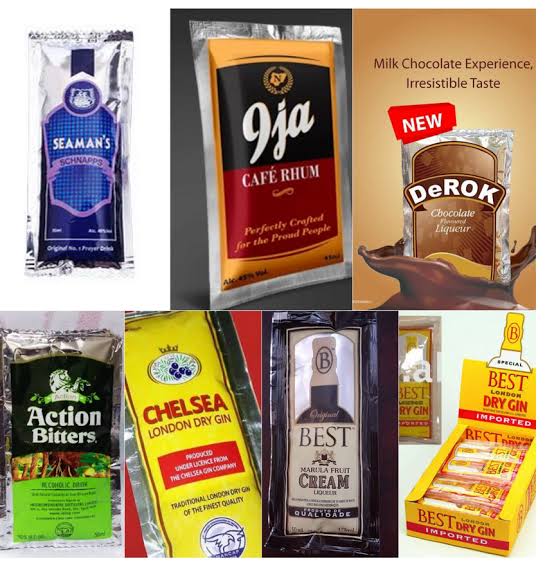
The Director-General of the National Agency for Food and Drug Administration and Control (NAFDAC), Prof. Mojisola Adeyeye, has announced the resumption of enforcement on the ban against the production and sale of alcoholic drinks in sachets and small PET or glass bottles below 200ml.
The action follows a recent directive by the Nigerian Senate.
In a statement to Independent Newspaper, Adeyeye clarified that the enforcement is not targeted at alcohol manufacturers. She said the Senate-backed decision, supported by the Federal Ministry of Health and Social Welfare, reinforces NAFDAC’s legal mandate to protect public health, especially children, adolescents, and young adults.
Follow PenTalk News
Get breaking news, important updates and the latest stories directly on your phone.
According to her, the easy availability of high-alcohol-content drinks in sachets and small bottles has made them cheap, portable, and easy to conceal. This has encouraged abuse and addiction among minors and some commercial drivers.
She noted that the growing misuse of such products has contributed to rising cases of domestic violence, road crashes, school dropouts, and other social problems.
Adeyeye stressed that warning labels such as “not for children” are ineffective within Nigeria’s social setting. Sachet alcohol is affordable and easy to hide, making supervision difficult. She cited reports from schools where pupils conceal alcohol sachets, including an instance where a student admitted he could not sit for an examination without taking alcohol.
NAFDAC recalled that manufacturers were granted a six-year moratorium to phase out sachet and small-bottle alcohol. In December 2018, the agency signed a five-year Memorandum of Understanding with the Federal Ministry of Health, the Federal Competition and Consumer Protection Commission (FCCPC), the Association of Food, Beverage and Tobacco Employers (AFBTE), and the Distillers and Blenders Association of Nigeria (DIBAN). The agreement required the elimination of small-volume packaging by January 31, 2024. The deadline was later extended to December 2025 to allow firms clear old stock and adjust production.
The current Senate resolution aligns with the agreement and Nigeria’s commitment to the World Health Assembly’s Global Strategy to Reduce the Harmful Use of Alcohol.
Adeyeye explained that the aim is to limit alcohol access for children and young people. She added that NAFDAC still approves alcohol sold in larger pack sizes, noting that the ban only applies to sachets and bottles below 200ml. No alcohol company has been shut down.
“This ban is not punitive; it is protective,” Adeyeye said. “It is designed to secure the health and future of our children and youth. The decision is based on scientific evidence and public health concerns. We must not trade the wellbeing of Nigerians for economic gain.”
NAFDAC reiterated that only two categories are affected: spirits packaged in sachets and those sold in PET or glass bottles under 200ml.
The agency urged manufacturers, distributors, and retailers to comply fully with the phase-out timeline, warning that no further extension will be granted beyond December 2025.
It also pledged continued collaboration with the Ministry of Health, FCCPC, and the National Orientation Agency to intensify nationwide awareness campaigns on the health and social risks of alcohol abuse.
NAFDAC reaffirmed its commitment to ensuring that Nigerians have access only to safe, well-regulated, and quality products.