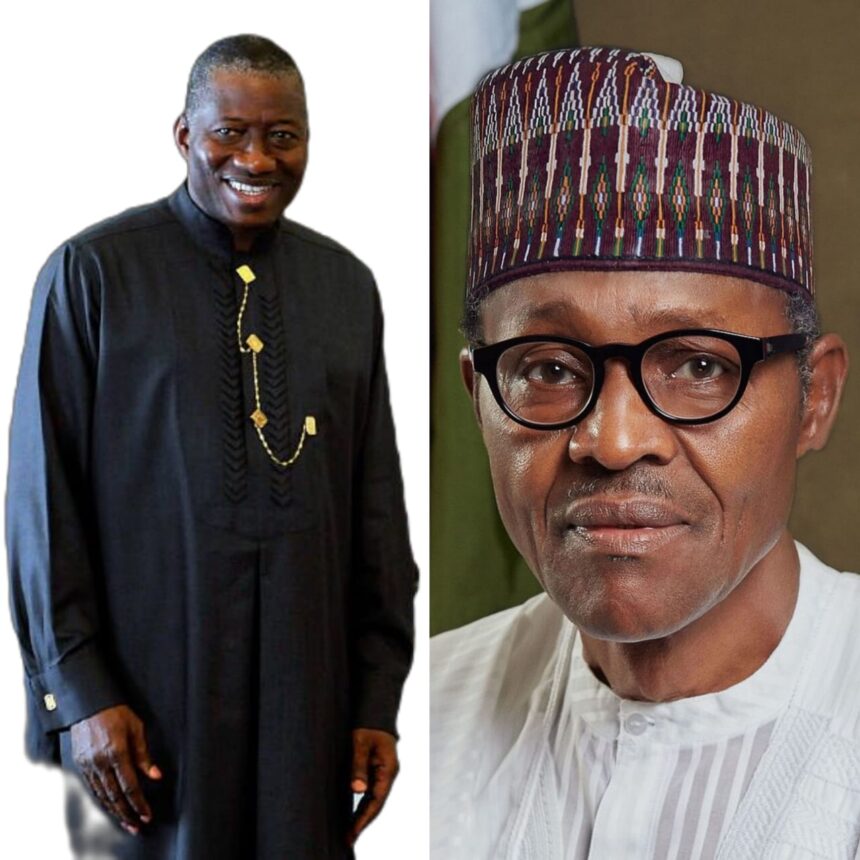
Former President Goodluck Jonathan has explained why he accepted defeat in the 2015 presidential election and handed over power to the late former President Muhammadu Buhari without challenging the outcome.
Jonathan said he conceded defeat because he regarded Buhari as a statesman who loved Nigeria and would put the country’s interests first.
The former president made the disclosure on Thursday, November 19, 2026, at the public presentation of Muhammadu Buhari: The Authorised Biography, a three-volume publication written by Dr Udu Yakubu in Abuja.
Follow PenTalk News
Get breaking news, important updates and the latest stories directly on your phone.
Jonathan was represented at the event by former Senate President and former Secretary to the Government of the Federation, Senator Anyim Pius Anyim, who delivered the message on his behalf.
According to Anyim, many Nigerians have continued to wonder why Jonathan conceded defeat to Buhari in 2015, particularly because Buhari’s victory marked the first time an incumbent Nigerian president lost an election and peacefully transferred power to an opposition candidate.
Explaining Jonathan’s decision, Anyim said the former president knew Buhari as a statesman who genuinely loved Nigeria and believed there was no reason to create unnecessary political tension over the election outcome.
He quoted Jonathan as saying that Buhari was a politician who successfully defeated a sitting president, while Jonathan became known as the African leader who willingly handed over power without resistance.
“It was easy for President Goodluck to say, ‘Look, this is a statesman that I know that will love Nigeria.’ So there was no need for any form of contention. That is the story,” Anyim said.
Anyim speaks on Jonathan’s relationship with Buhari
Reflecting on his personal relationship with the late president, Anyim traced their association to 2003, describing it as a father-and-son relationship.
He explained that Buhari maintained a cordial relationship with him even after he joined Jonathan’s administration, despite Buhari being in the opposition.
According to Anyim, Buhari continued to show him respect and occasionally visited him, demonstrating that political differences did not prevent them from maintaining personal relationships.
He added that Buhari was accorded respect and recognised as a statesman throughout Jonathan’s administration, notwithstanding his position in the opposition.
Shettima, Babangida pay tribute to Buhari
Also speaking at the event, Vice-President Kashim Shettima described Buhari as a remarkable figure who stood out in Nigerian politics.
Shettima, who was represented by the Special Adviser on General Duties to the President in the Office of the Vice-President, Dr Aliyu Modibbo Umar, said Buhari demonstrated that the dignity of public office depended on the character of the person occupying it.
He also emphasised the importance of documenting the lives and experiences of national leaders, warning that failure to tell one’s story could allow others to shape the narrative.
Former Military President Ibrahim Babangida also paid tribute to Buhari, describing him as a comrade-in-arms with whom he shared experiences in the Nigerian Armed Forces.
Babangida, represented by former Inspector-General of Police Mohammed Abubakar, recalled their military training and shared experiences, saying they had worked together in the interest of Nigeria’s peace and unity.
Nasarawa State Governor Abdullahi Sule also praised Buhari’s honesty, patriotism and uncompromising position against corruption.
Similarly, BUA Group Chairman Abdulsamad Rabiu, represented by Senator Lawal Shuaibu, described the late president as a dependable figure who supported him during difficult periods in his personal life and business.
Issoufou speaks on Buhari’s democratic legacy
Former Niger Republic President Mahamadou Issoufou, who chaired the occasion, described himself as a personal friend of Buhari and praised his respect for constitutional term limits and the peaceful transfer of power.
Issoufou recalled that Niger was the first country Buhari visited after his inauguration on June 3, 2015. He also noted that he conferred the Grand Cross of the National Order of Niger on the Nigerian leader in March 2021.
However, he cautioned against treating any biography as the final account of Buhari’s life and political legacy, noting that no single publication could capture every aspect of the former president.
The Chairman of the Planning Committee, Suleiman Adamu, disclosed that the biography was personally authorised by Buhari.
The author, Dr Udu Yakubu, said the project took more than two and a half years to complete, adding that Buhari granted him access while he was still alive.
Yakubu explained that although Buhari did not always agree with his questions or provide the answers he expected, he nevertheless participated in the process.
He also acknowledged the contributions of Mamman Daura, who helped provide access and clarify historical timelines, while insisting that a biography of such importance should remain open to public scrutiny.