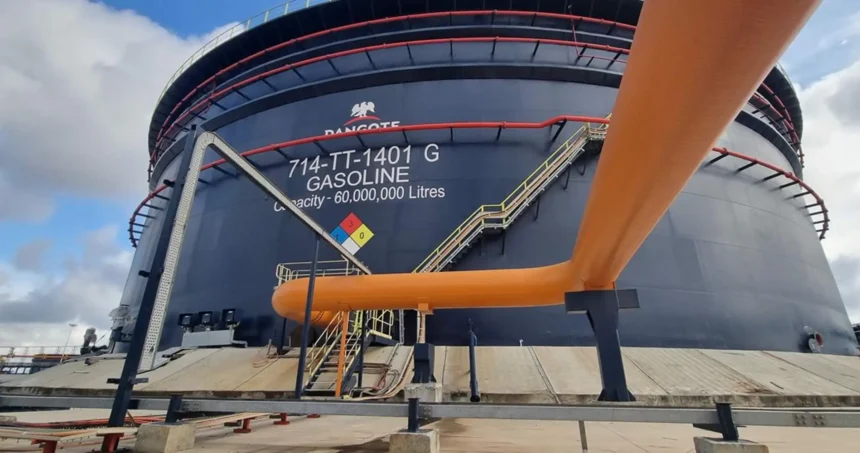
The Dangote Petroleum Refinery has increased its gantry prices for petrol and diesel, heightening concerns over rising energy costs for households and businesses across Nigeria.
A senior refinery official confirmed the adjustment on Tuesday night, attributing the move to fluctuations in international crude oil prices and prevailing market conditions.
Under the new pricing structure, petrol increased by N75 per litre to N1,275, representing a 5.02 per cent rise. Diesel saw a steeper hike of N200 per litre, reaching N1,950.
Follow PenTalk News
Get breaking news, important updates and the latest stories directly on your phone.
This marks a significant jump from last month’s prices of N1,200 per litre for petrol and N1,750 for diesel. The revised diesel price also edges closer to the N2,000-per-litre threshold, a development likely to drive up operational costs for businesses and transportation services.
The refinery official explained that the adjustment reflects global market dynamics, particularly geopolitical tensions affecting crude oil supply.
“The adjustment is in line with global market trends. Ongoing tensions in the Middle East have impacted crude oil prices, and these external factors directly influence refined product pricing,” the official said.
He reiterated that petrol rose by N75 to N1,275 per litre, while diesel climbed by N200 to N1,950, in line with current international market realities.
Data from Petroleumprice.ng confirmed the development, noting that the petrol price increase represents a 5.02 per cent rise at the gantry level.
The price adjustment comes despite earlier expectations that increased local refining capacity would help stabilise fuel costs. However, analysts note that Nigeria remains vulnerable to global oil price movements, as refined product pricing is still tied to international crude benchmarks.
Industry experts also warn that the higher gantry prices could translate into increased pump prices nationwide, as marketers are likely to pass the additional costs on to consumers.
Global oil markets have experienced heightened volatility in recent weeks due to escalating tensions in the Middle East, a key hub for global crude supply. Any disruption or perceived risk to supply routes often triggers price surges across energy markets.
Although Nigeria is a major crude oil producer, its deregulated downstream sector means fuel prices are largely determined by market forces, including global crude prices, exchange rates, logistics costs, and refinery operations.
While the Dangote Petroleum Refinery, Africa’s largest refining facility, was expected to reduce reliance on fuel imports and stabilise domestic prices, experts say local fuel costs will continue to fluctuate as long as they remain linked to global oil benchmarks.