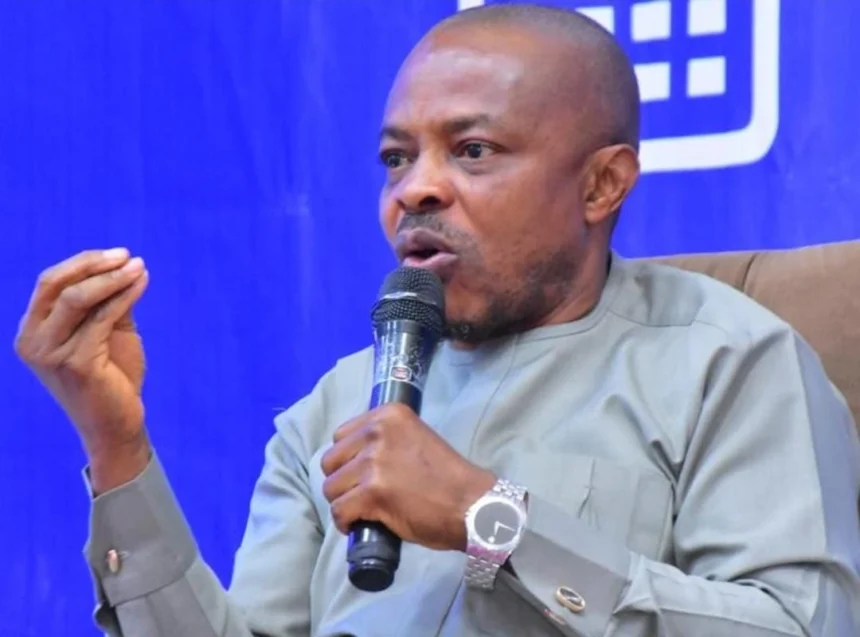
The President of the Nigeria Labour Congress (NLC), Joe Ajaero, has warned that introducing a ₦1 million minimum wage without addressing the country’s underlying economic challenges could destabilise Nigeria’s economy, stressing the need to improve workers’ purchasing power amid rising living costs.
Ajaero made the remarks during an interview on Channels Television’s The Morning Brief on Thursday, October 29, 2026, as discussions over workers’ wages and the Federal Government’s response to rising transportation costs continued.
According to reports, the labour leader argued that increasing salaries alone would not resolve the financial difficulties facing Nigerian workers if the prices of essential goods and services continued to rise.
Follow PenTalk News
Get breaking news, important updates and the latest stories directly on your phone.
He maintained that the government should prioritise measures to strengthen the naira’s purchasing power and tackle the factors driving the high cost of living.
“N1,000,000 minimum wage will collapse the Nigerian economy,” Ajaero stated.
The NLC president’s comments come amid growing concerns over the ability of Nigerian workers to meet their basic needs as food, transportation and other essential expenses continue to put pressure on household budgets.
Many workers have complained that their earnings no longer adequately cover daily expenses, increasing calls for improved wages and policies that would ease the burden of rising prices.
Ajaero’s position highlights the relationship between salary increases and the cost of goods and services, suggesting that wage adjustments must be considered alongside broader economic conditions.
However, his warning about a ₦1 million minimum wage reflects his assessment of the potential economic consequences and does not, by itself, establish what the actual impact of such a policy would be.
NLC Demands Fresh Minimum Wage Negotiations
The NLC has continued to push for a review of the national minimum wage, arguing that the current ₦70,000 monthly rate has become inadequate under prevailing economic conditions.
Earlier in October, the union issued the Federal Government a two-week ultimatum, demanding fresh minimum wage negotiations, a reduction in petrol prices and other measures to ease the hardship facing workers.
The labour movement has also called for tax relief and interventions to cushion the effects of rising transportation and living costs.
Meanwhile, the Federal Government has approved a ₦70,000 monthly transport allowance for eligible public sector workers for six months. The measure has generated disagreement between the NLC and the Trade Union Congress (TUC), with the latter arguing that a temporary allowance does not adequately address the need for salary increases.
The debate over wages, inflation and workers’ welfare is expected to remain a major issue as organised labour presses for measures that would improve living standards across Nigeria.