

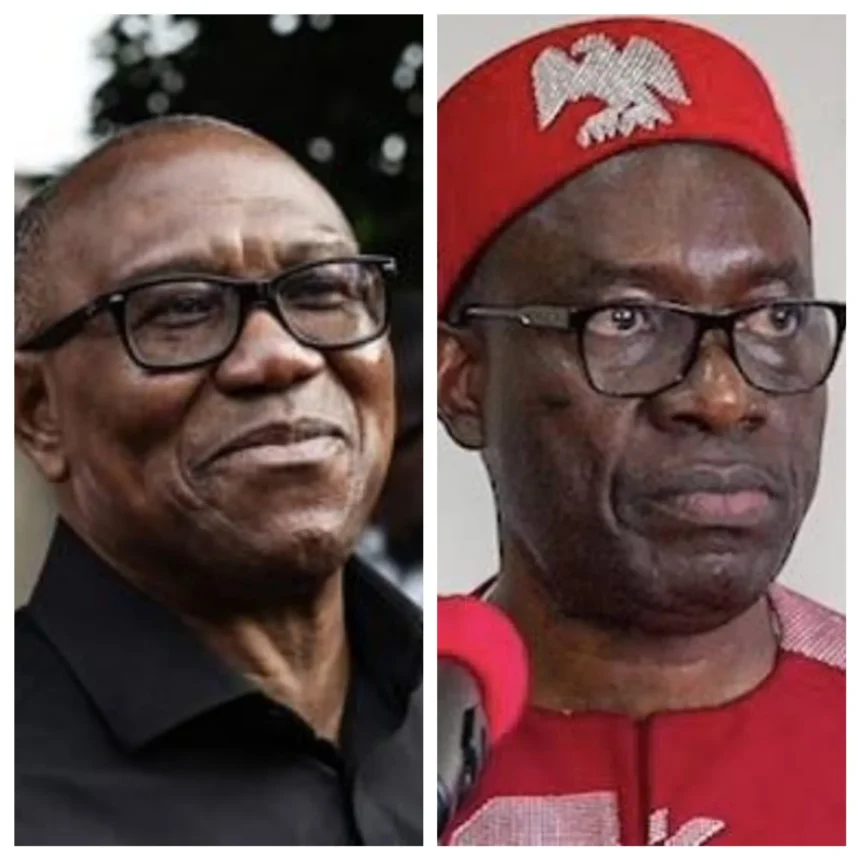
The political tension between former Anambra State Governor Peter Obi and the administration of Governor Chukwuma Soludo has escalated, following a fresh exchange over the former governor’s influence and the direction of the state ahead of the 2027 general elections.
The latest disagreement began after the Anambra State Government called on voters to reject Obi and his political platform.
The message, circulated through Governor Soludo’s New Media office, accused Obi of working against the interests of the All Progressives Grand Alliance (APGA) and appealed to members and supporters of the party not to support him.
Follow PenTalk News
Get breaking news, important updates and the latest stories directly on your phone.
Reacting on Monday, Peter Obi Media Reach (POMR), through its spokesman, Idris Zekeri Jnr., criticised the state government’s position and accused the administration of paying too much attention to the former governor.
In a statement titled “Stop Chasing Shadows,” Zekeri argued that the Soludo administration should be more focused on governance and the challenges facing residents than on political attacks against Obi.
He specifically mentioned infrastructure, education, erosion, environmental concerns and public safety as areas requiring greater attention.
Zekeri further alleged that concerns had been raised within the State Executive Council over what he described as the governor’s continued focus on Obi. However, the claim was made by Obi’s media office and was not independently verified.
The POMR spokesman challenged the administration to defend its record in office rather than concentrate on the former governor.
He argued that the government should demonstrate how available public resources were being used to improve roads, tackle erosion and address other pressing issues across the state.
The statement also brought the debate over Anambra’s performance rankings back into the political conversation.
POMR referred to the 2026 Phillips Consulting State Performance Index (pSPI), which placed Anambra 27th among Nigeria’s 36 states.
The ranking has to be viewed alongside previous editions of the index. Anambra was ranked eighth in 2024, dropped to 34th in 2025 and moved to 27th in the 2026 assessment.
Phillips Consulting also changed aspects of its methodology for the 2026 edition and included newly available audited financial statements for 2025.
Obi’s camp interpreted the latest position as evidence of a decline in the state’s performance. The Soludo administration, however, has previously questioned aspects of the pSPI methodology and maintained that the rankings do not fully capture its programmes, investments and reforms.
The state government has repeatedly highlighted its work in areas such as road construction, education and healthcare.
The Anambra State Ministry of Education has also said the administration introduced free education from nursery to senior secondary school while expanding school infrastructure and digital-learning initiatives.
Despite those claims, POMR maintained that the resources available to the state should result in more visible improvements in the daily lives of residents.
Obi’s Record Also Comes Into Focus
The statement also defended the record of Obi’s administration, particularly in urban planning.
Zekeri pointed to the former governor’s collaboration with UN-Habitat on master and structural plans for major cities in Anambra, arguing that subsequent administrations should have continued from those foundations.
Obi’s media office also accused the Soludo administration of using large numbers of online supporters to attack the former governor.
No independent evidence was provided in the statement to support that allegation.
POMR further criticised what it described as shortcomings in the government’s response to flooding and other environmental challenges. Some of the claims concerning the implementation of weather and disaster warnings could not be independently verified from the material released by the group.
The latest exchange comes as political activity surrounding Obi’s influence in Anambra and his wider role in national politics continues to intensify ahead of the 2027 elections.
Obi, who governed Anambra between 2006 and 2013, remains a significant political figure in the South-East and across Nigeria.
His media office cited large gatherings involving the former governor, including events in Nnewi and Adazi-Ani, as evidence of his continued grassroots support in the state.
POMR subsequently appealed to traditional rulers, religious leaders, elders and other influential stakeholders in Anambra to encourage political actors to prioritise governance and public development.
The group maintained that the central issue should be the delivery of services and measurable progress rather than continued political attacks.
The dispute has increasingly developed into a clash between two competing narratives: Obi’s camp continues to defend his record and political influence, while the Soludo administration points to its ongoing reforms and investments as evidence of its own performance.
With the 2027 elections already dominating political discussions, the latest confrontation indicates that the debate over Obi’s legacy and Soludo’s record in office is likely to remain an important part of Anambra’s political landscape.
Additional Source: The Nation




