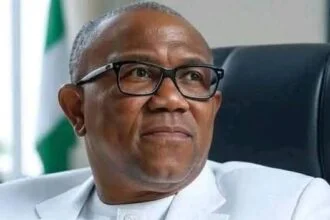
The Nigeria Democratic Congress (NDC) has said its presidential candidate, Peter Obi, is determined to stop what it described as the erosion of Nigeria’s commonwealth if elected president in 2027.
The party made the declaration in response to President Bola Tinubu’s recent remarks about erosion challenges in Anambra State during an All Progressives Congress (APC) gathering in Akwa Ibom State.
Tinubu, while addressing party supporters in Uyo, criticised the handling of erosion problems in Anambra State during Obi’s tenure as governor, contrasting it with his own efforts to tackle the Atlantic Ocean’s impact on Lagos.
Follow PenTalk News
Get breaking news, important updates and the latest stories directly on your phone.
Reacting in a statement, the NDC said the mission of Obi and his running mate, Rabiu Musa Kwankwaso, extended beyond the environmental challenges raised by the President.
The statement, signed by Dr Chiogo Ikokwu, spokesperson of the NDC National Presidential Campaign Council, said the party’s priority was to address what it called the rapid erosion of Nigeria’s commonwealth.
According to the NDC, the Obi-Kwankwaso ticket intends to tackle the contradiction between the expected financial benefits of fuel subsidy removal, increased government revenue, rising borrowing and inadequate funding of essential public services.
The party questioned what had happened to the savings expected from subsidy removal, arguing that Nigerians were yet to experience corresponding improvements in healthcare, education and other critical sectors.
It also criticised the Tinubu administration’s borrowing, poor debt-service-to-revenue ratio and the economic difficulties facing citizens, including rising poverty, unemployment, insecurity and declining purchasing power.
The NDC further compared the financial records of Obi and Tinubu during their respective tenures as governors of Anambra and Lagos states.
It claimed that Obi left investments worth approximately $500 million, including $156 million in dollar-denominated bonds, when he left office in 2014.
The party also cited Debt Management Office figures which it said showed that Lagos State’s external debt stood at approximately $190.43 million at the end of 2007, when Tinubu handed over power.
On pension benefits, the NDC criticised the Lagos State pension law introduced during Tinubu’s administration, arguing that it provided substantial lifetime benefits for former governors and their deputies.
The party listed some of the benefits as pensions equivalent to 100 per cent of the incumbent governor’s basic salary, houses in Lagos and Abuja, vehicles, furniture allowances, medical care and domestic staff.
It contrasted this with Obi’s administration in Anambra, claiming that he did not establish a similar pension arrangement for former governors.
The NDC said its presidential ticket represented an alternative to what it described as a borrowing-dependent and wasteful approach to governance, promising prudent management of public resources, accountability and productive investment.
It maintained that Nigeria needed leadership focused on improving citizens’ welfare rather than accumulating debts without corresponding benefits.