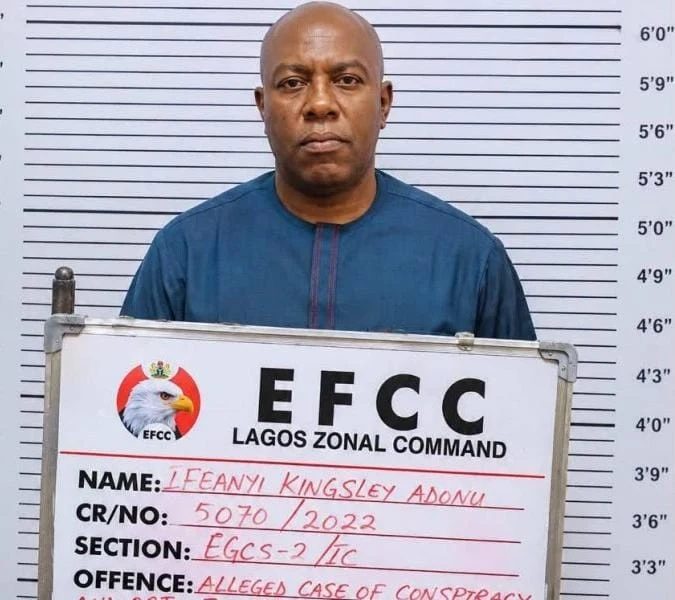
The Economic and Financial Crimes Commission (EFCC) has arraigned a businessman, Adonu Kingsley Ifeanyi, and his company, S Mobile Netzone Limited, before the Federal High Court in Lagos over an alleged fraud involving ₦12.56 billion.
The defendants appeared before Justice Yellim Bogoro, where they faced five counts bordering on obtaining money by false pretence and stealing.
According to the EFCC, the total amount involved in the alleged offences is ₦12,556,837,842.
Follow PenTalk News
Get breaking news, important updates and the latest stories directly on your phone.
In a statement issued on Monday, November 2, 2026, the commission’s spokesperson, Dele Oyewale, disclosed that the defendants pleaded not guilty to all five charges.
One of the charges alleged that Ifeanyi received approximately ₦1.24 billion through an account belonging to S Mobile Netzone Limited between June 4, 2021, and October 31, 2022.
The EFCC further alleged that he received another ₦6.79 billion through the same company account between January 15, 2020, and April 14, 2022, allegedly knowing that the funds were proceeds of stealing.
EFCC Had Previously Flagged Company
S Mobile Netzone Limited had previously been mentioned by the EFCC in March 2025 as one of 58 companies identified in a public alert over alleged illegal investment schemes.
At the time, the commission warned Nigerians against dealing with the listed companies, stating that they were not registered with the Central Bank of Nigeria (CBN) or the Securities and Exchange Commission (SEC).
Court Grants Defendants Bail
Following the defendants’ not-guilty pleas, the EFCC prosecution lawyer, Suleiman I. Suleiman, asked the court to fix a date for the commencement of trial.
Justice Bogoro subsequently granted the request and admitted the defendants to bail under the same terms and conditions earlier granted by another judge, Justice C. J. Aneke, on July 8, 2025.
The court adjourned the matter for the commencement of trial.
The allegations have not been established in court, and the defendants remain entitled to the presumption of innocence until proven guilty.