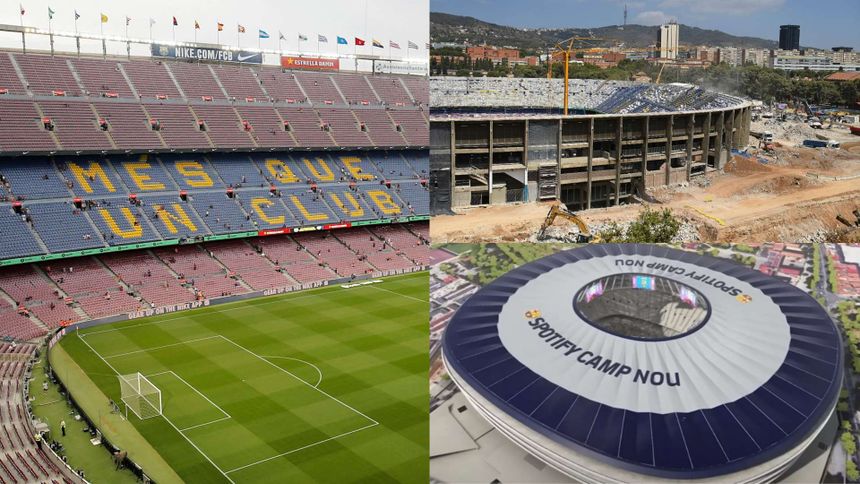
Barcelona are preparing to leave the Camp Nou once again as construction work on the stadium enters another crucial phase.
The club had previously indicated that another temporary move would be necessary to complete the redevelopment. However, vice-president Ferran Olive provided more details during Saturday’s annual general assembly, outlining when the move is expected to happen and when the team could return.
According to Olive, Barcelona will complete the 2026-27 season at the Camp Nou before moving away from the stadium for roughly half of the following campaign. The club is targeting a return in January 2028.
Follow PenTalk News
Get breaking news, important updates and the latest stories directly on your phone.
The announcement came as members approved another major borrowing package worth €510 million (£437 million; $584 million). Of that amount, €300 million will be used for Camp Nou construction, while a further €210 million will cover the club’s operational financing needs.
The approval means Barcelona’s overall debt could rise beyond €2 billion and potentially reach approximately €2.6 billion, depending on repayment schedules.
The latest financing also increases the projected cost of the wider Espai Barca redevelopment to €1.8 billion. That figure is three times the €600 million budget originally approved by members in 2014.
Even the revised figure does not cover every element of the wider project. Club president Joan Laporta told members that the additional €300 million allocated to the Camp Nou will not fund construction of the Palau Blaugrana, the planned arena for Barcelona’s non-football teams.
Why Does Barcelona Have to Leave the Camp Nou Again?
The simple reason is that construction is still ongoing.
Barcelona originally left the Camp Nou in May 2023 and were expected to return in November 2024. Delays to the redevelopment pushed that return back considerably.
The club spent the entire 2023-24 and 2024-25 seasons playing at the Estadi Olimpic Lluis Companys on Montjuic, around 3.5 miles from the Camp Nou.
Further delays last season forced Barcelona to stage two La Liga home matches at the much smaller Estadi Johan Cruyff, which has a capacity of about 6,000 and is located near the club’s training facilities.
The team eventually returned to the Camp Nou, playing their first match there on November 22, 2025, when they defeated Athletic Club 4-0 in La Liga. The stadium was initially operating at a reduced capacity of around 45,000.
Capacity has since increased to approximately 62,000, with the first and second tiers fully completed. That number is expected to increase further when sections of the third tier begin opening from early 2027.
However, completing the roof presents another major challenge.
Under the stadium’s design, the roof must be constructed from inside the ground. This means construction equipment and materials will need to occupy the pitch area, making it impossible for Barcelona to continue playing there during that stage.
Where Will Barcelona Play?
Olive said roof construction would begin gradually once Barcelona play their final match of the 2026-27 season in May.
The club has already reached an agreement with Barcelona’s city council to return to the Estadi Olimpic Lluis Companys, the stadium used during the 1992 Olympic Games.
The venue has a football capacity of approximately 45,000 and is expected to host Barcelona’s home matches during the temporary move.
Olive said the club expects to return to the Camp Nou in January 2028, with the stadium then capable of accommodating about 95,000 spectators.
That would still be below the eventual target. The completed Camp Nou is planned to hold around 105,000 people, compared with its previous official capacity of 99,354.
Barcelona currently expect the stadium to be fully completed and operating at its maximum capacity by the beginning of the 2028-29 season.
The project has also gained international significance after UEFA selected the Camp Nou to host the 2029 Champions League final, scheduled for June 2 of that year.
Olive acknowledged the possibility of further delays but said the club had deliberately allowed additional time in its schedule.
Barcelona expect the major roof components to be completed by October or November 2027. However, the January 2028 return date is intended to provide a buffer should construction take longer than anticipated.
Previous delays have already had significant financial consequences.
Barcelona have missed out on the additional matchday income expected from their redeveloped stadium, while the club has reported €17 million in operating expenses and another €24 million in investment connected with the current construction phase.
Barcelona’s city council has also confirmed that the club has arranged to use Montjuic until January of the 2027-28 season.
How Much Will the Camp Nou Project Cost?
The cost of Barcelona’s stadium redevelopment has increased dramatically since the original proposal was approved.
In April 2014, club members approved a €600 million budget covering the refurbishment and expansion of the Camp Nou, alongside improvements to facilities around the stadium.
The original plan was expected to be carried out between May 2017 and March 2021, but those works never progressed as initially planned.
When Joan Laporta returned for his second spell as club president in March 2021, the original budget was abandoned. Changes were subsequently made to the design and construction plans, and members approved a new budget of €1.5 billion.
Barcelona later appointed Turkish construction company Limak to handle the redevelopment. The club said the company offered the lowest cost and fastest construction proposal among the applicants.
In 2023, Barcelona and Limak said they expected the stadium to be fully completed by summer 2026.
That deadline was not met.
Earlier this month, financial projections presented to members indicated that another €300 million would be borrowed for the stadium project, taking the expected Espai Barca budget to €1.8 billion.
However, members were ultimately asked to approve €510 million in additional borrowing.
The package consists of €300 million for the Camp Nou redevelopment and €210 million in additional operational financing. The latter is secured against future television revenue.
The additional non-Espai borrowing has raised concerns because it is not directly tied to the long-term stadium project.
Barcelona had €1.840 billion in total borrowings at the end of June 2026, with €597 million classified as non-Espai debt. The additional €210 million would therefore push that portion of the club’s borrowing beyond €800 million.
A €105 million portion of the new operational borrowing was issued in July. Previous reports indicated that the money appeared to have been used partly to meet outstanding transfer-related payments.
Barcelona has attributed the additional financing needs to cash-flow pressures caused by delays to the Camp Nou redevelopment.
The first €105 million tranche carries a fixed interest rate of 5.14 per cent. That is higher than the rate attached to some of the club’s other borrowing and is around two percentage points above the weighted average rate on Real Madrid’s own substantial debt.
The higher rate could result in significantly greater interest costs over the lifetime of the borrowing. Even before the latest financing, Barcelona paid approximately €91 million in net interest during the 2025-26 financial year.
The interest rate for the second €105 million tranche, expected to be issued before Christmas, has yet to be disclosed.
When the maximum €1.8 billion in Espai Barca financing is combined with the club’s operational debt, Barcelona’s total borrowings could exceed €2.6 billion.
That figure does not include the 25 per cent of La Liga television revenue Barcelona sold to private equity firm Sixth Street in 2022.
It also does not resolve how the Palau Blaugrana will ultimately be financed. When the Espai Barca budget was last revised in 2021, the proposed arena and surrounding facilities were estimated to cost about €420 million.
Laporta told members that the club was exploring alternative ways to finance the Palau Blaugrana and insisted that doing so would not require Barcelona to increase its already substantial debt burden.
“We are looking at alternatives,” the president said.
Source: The Athletic | Culled by: Ed Mic